Car Dealership Photography: Tips and a Checklist for Every Listing
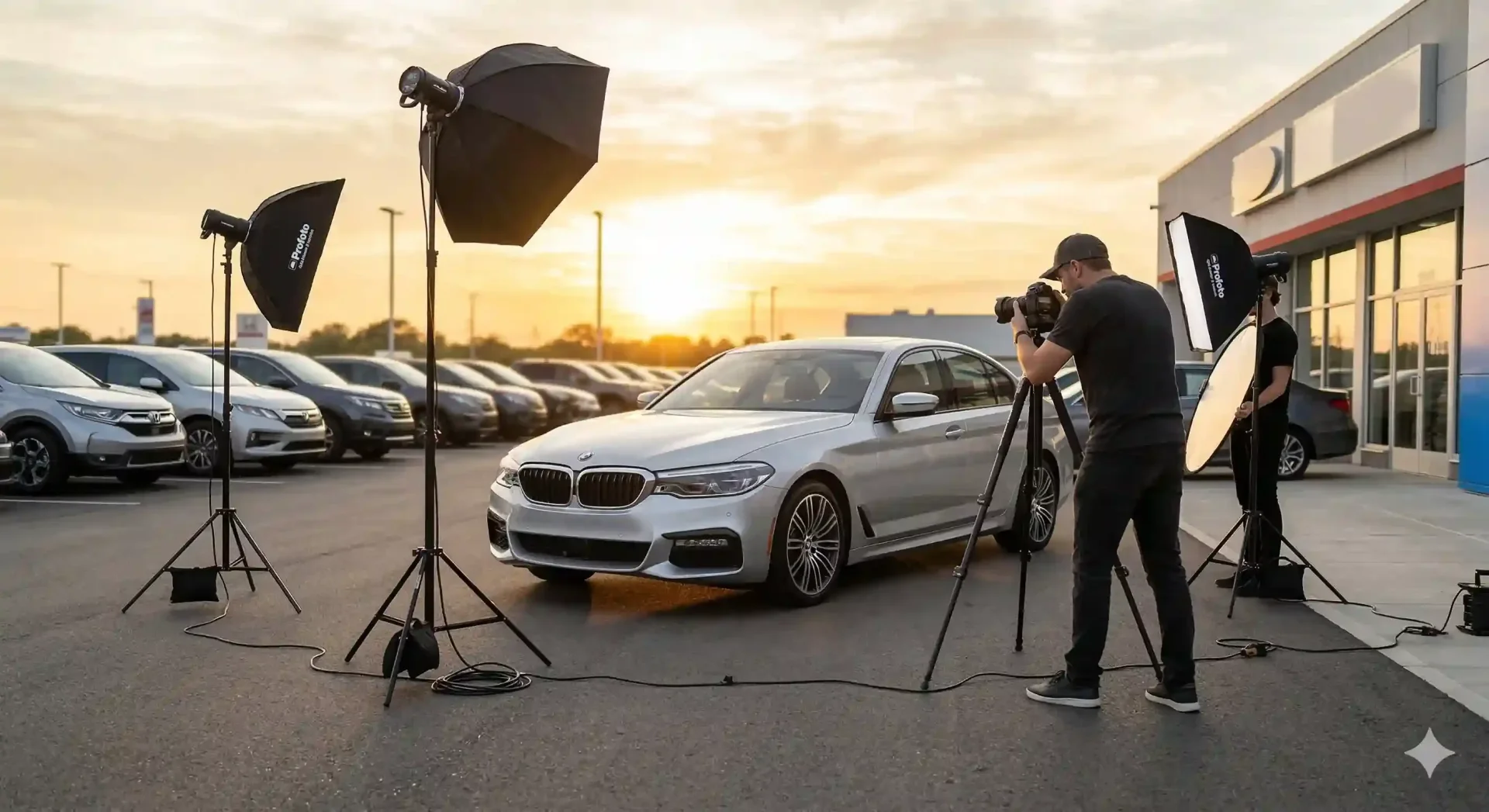
The car dealership photography tips that matter most are simple: clean every car, shoot it in the same spot and the same order, and edit every set to one standard. Dealership photography is less about the camera and more about a routine your whole team follows.
That routine covers the shoot and everything after it. A car dealership photo editor handles the backgrounds and lighting, but it works far better when the photos coming in are already clean and consistent. Below is the full process, with a 15-point checklist your team can print.
Why dealership photography drives faster sales
Every car on your lot competes with hundreds of others on Cars.com, CarGurus, AutoTrader and Facebook Marketplace. Buyers scroll fast, and they stop on the listing that looks trustworthy.
Photos are what earn that stop. Cox Automotive found that listings with multiple custom photos get a 349% lift in click-throughs to the vehicle detail page compared with a single stock image, on used and CPO listings.
Good photos also save your sales team time. When a car looks ready to buy online, you get fewer "can you send more pictures" messages and less back-and-forth about condition.
Consistency adds up across the lot. A buyer who sees 30 cars all shot to the same standard reads your dealership as organized before they ever visit.
Car dealership photography tips: the 15-point checklist
Consistency beats perfection here. One stunning hero shot next to 14 mediocre ones hurts more than 15 photos that are all good. These 15 checks cut the most rework, grouped by when they happen.
# | Check | Why it saves rework |
1 | Clean the car inside and out | Dirt and water spots can't be edited out convincingly |
2 | Remove price stickers, paper mats and personal items | Nothing to crop or reshoot later |
3 | Park in your standard photo spot | The same background and light on every car |
4 | Set the seats and wheel, then close everything | No restaging between exterior and interior shots |
5 | Use the same device, set up the same way | Different phones shoot different color |
6 | Lock exposure on the car's body | Every angle comes out at the same brightness |
7 | Turn off scene detection and filters | Auto features re-style each shot differently |
8 | Wipe the lens before each car | A smudge softens every photo in the set |
9 | Follow the same shot order | Nothing gets missed, and files stay organized |
10 | Keep the same distance and height | The listing grid looks like one shoot |
11 | Leave 10 to 15% of the frame around the car | Room to crop for each marketplace |
12 | Check focus before moving on | A soft shot can't be fixed later |
13 | Avoid harsh midday sun | Fewer blown highlights and deep shadows |
14 | Wear dark, plain clothes and watch the paint | You and your logo stay out of the reflections |
15 | Keep the sun behind you or to the side | Backlight blows out the windows |
Print it and keep a copy with whoever shoots. The cleaning check pays off the most, because dirt causes more reshoots than any other single problem.
The shot order matters just as much. The 12 car photography angles give your team one sequence to follow on every car, from the front three-quarter to the trunk.
Setting up a dealership photography workflow
The hardest part of dealership photography usually isn't the shoot. It's what happens after, when photos sit on someone's phone waiting to be edited while the car sits unlisted.
A workflow that keeps cars moving looks like this:
- Clean the car within 24 hours of it arriving on the lot.
- One designated person shoots the full sequence plus condition close-ups.
- Upload the set straight from the phone or desktop to your editor.
- Apply the same background and lighting template to every car.
- Review the edges and paint color on each set before export.
- Export and upload to your listing platforms.
The review step only takes a moment per car, and it's the one teams skip most. It's also where you catch a blurry shot or a missing angle before a buyer does.
Equipment and settings that matter
You don't need a professional camera. A recent iPhone or Galaxy phone shoots at 12 megapixels or more, which is plenty for any marketplace.
How you use it matters more. Shoot in landscape at the 4:3 aspect ratio, keep the flash off, and never use digital zoom. HDR can stay on, since it balances a bright sky against a dark underbody.
A clip-on polarizing filter is the cheapest upgrade you can make. It cuts glare on glass and paint for well under $20. For exposure lock, white balance and the full phone and DSLR setup, the car photography settings for lot conditions go step by step.
Common dealership photography mistakes and fixes
Inconsistent backgrounds
Different people shoot in different spots, so one car has a building behind it and the next has a dumpster. Pick one photo corner with the cleanest background, or replace the background on every car after the shoot. Choosing between a white or outdoor car background once keeps the whole inventory matched.
Skipping the interior
Exteriors get the attention, but buyers use interior photos to judge condition and comfort. Always shoot the dashboard, the rear seats and the trunk at a minimum.
Shooting in harsh midday light
Noon sun puts deep shadows under the car and glare across the windshield. The softer golden hour light after sunrise and before sunset is far easier on paint.
Shoot before 10 AM or after 3 PM when you can, or move the car into open shade.
No quality check before publishing
Photos go straight from the camera to the listing without anyone looking for blur, wrong angles or clutter. One person checking each set before upload catches those problems early.
Scaling dealership photography across locations
For a single rooftop, a phone and good habits can carry you a long way. Multi-location groups need a written standard.
Put the shot sequence, the background choice and the checklist into one SOP, and train one designated photographer per site. Then edit everything through the same tool with locked templates, so every location produces identical output no matter who shoots or what the lot looks like.
That's where a car dealership photo editor earns its place. Background replacement, lighting and color correction happen in one pass, so your staff only needs to shoot and review.
Final thoughts
Good dealership photography comes from a repeatable system, not expensive gear. Start with the checklist, set up one photo spot, and edit every car to the same standard. Getting the light right helps too, and professional car photos come from pairing soft light with that routine.
Then test it on your own stock. Take the three worst-photographed cars on your lot and run them through Car Background AI. Check the window edges and the shadow under each car. If they don't hold up, close the tab.
10 free generations. No card required.
Frequently asked questions
Do I need a professional camera for car dealership photography?
No. A recent phone with 12 megapixels or more meets every marketplace standard. Clean cars, consistent light and a fixed shot sequence matter far more than the camera.
How many photos should I take per vehicle?
Start with the 12 core angles, then add condition close-ups. Where the marketplace allows it, a full set runs to about 36 photos, the average in our listing study of 465 photos across 13 dealer listings, which heads off most "can you send more pictures" requests.
What time of day is right for dealership photo shoots?
Early morning or late afternoon, roughly before 10 AM or after 3 PM depending on the season. Overcast days work at any hour. At midday, move the car into open shade.
How can I standardize photography across multiple locations?
Write one SOP with the shot sequence, the background choice and the checklist. Train one photographer per site, and edit every location's photos with the same locked templates.
How much does car dealership photography cost?
Outsourced dealer photography usually runs about $15 to $30 per car. Editing in-house with Car Background AI starts at $29 a month for up to 75 photos, with 10 free generations to try it first.
What car dealership photography tips make the biggest difference?
Clean the car before every shoot, use the same background across your inventory, and shoot at the same time each day. Together, those turn a scattered inventory page into one that looks like a single dealership.
جرّب مجانًا على سيارتك التالية
ارفع صورة من ساحة المعرض واستلمها بخلفية استوديو أو صالة عرض. 10 عمليات توليد مجانية دون بطاقة دفع.
جرّب مجانًا
يستخدمه أكثر من 1,000 معرض سيارات.

Tamas Magda
شريك مؤسس ومسؤول النمو والشراكات في Car Background AI
شارك Tamas Magda في تأسيس Car Background AI (carbackground.ai)، محرر صور السيارات بالذكاء الاصطناعي الذي يستبدل خلفيات صور مخزون المعارض. يقود الشراكات والنمو وهيكلة الأعمال، ويعمل مع فريق التطوير على خارطة طريق المنتج، ومع المعارض على ما تحتاج إليه إعلاناتها على الإنترنت فعلًا. يحمل خبرة في بناء المشاريع الناشئة في آسيا والمحيط الهادئ وفي الشرق الأوسط وشمال إفريقيا، ويكتب عن عرض المركبات للبيع، ومسارات عمل الصور في المعارض، واستخدام الذكاء الاصطناعي في صور الإعلانات دون تغيير السيارة نفسها.
الكاتب Tamas شريك مؤسس في Car Background AI وله مصلحة مالية في الشركة. والمقالات التي تذكر Car Background AI تعكس هذه العلاقة.