Car Background AI vs Manual Photoshop Editing: Which Delivers Better Results Faster
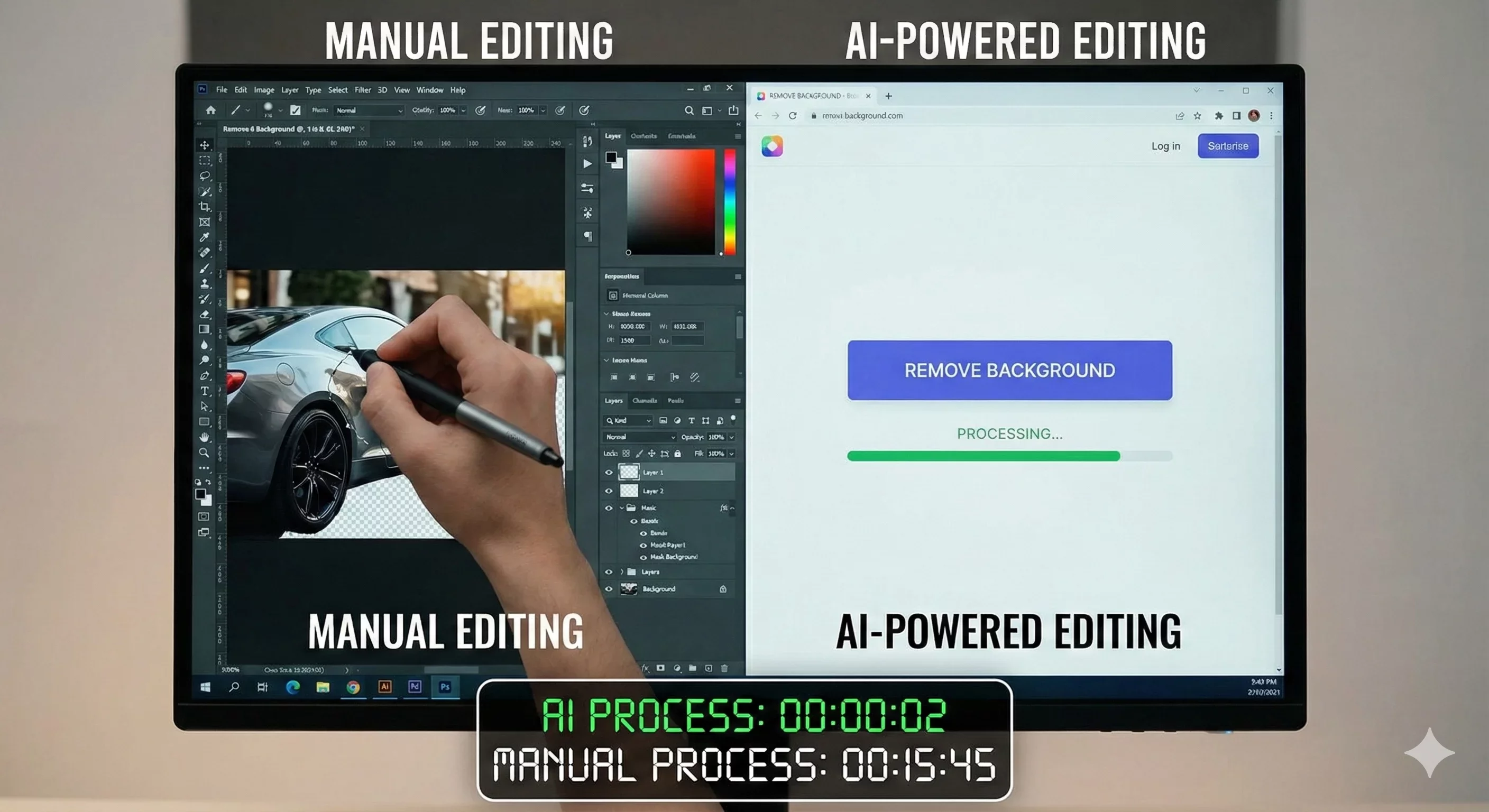
Car background AI and manual Photoshop editing both produce professional vehicle photos, but they differ dramatically in speed, consistency, skill requirements, and scalability. This comparison helps dealers understand which approach fits their volume, team capabilities, and quality expectations.
Neither option is universally superior. The right choice depends on your specific operational context.
Speed: The Most Obvious Difference
The time required to process one vehicle photo set defines how quickly new inventory reaches your listings and how much labor each vehicle consumes.
Manual Photoshop Editing
A skilled editor working in Photoshop needs fifteen to forty-five minutes per photo for quality background replacement. This includes creating accurate selections around complex vehicle edges, removing the original background, placing and adjusting the new background, adding appropriate shadows, matching lighting, and verifying edge quality.
For a typical twelve-photo vehicle set, manual editing requires three to nine hours of skilled labor. Multiply across monthly inventory volume to understand total staff time commitment.
Car Background AI
AI-powered tools process individual photos in seconds to minutes. Batch processing handles complete vehicle sets simultaneously. A twelve-photo set typically completes in under five minutes, including quality review time.
The speed difference is not marginal but fundamental. What takes a manual editor an entire workday, AI accomplishes during a coffee break.
Verdict
For dealers processing more than a handful of vehicles monthly, AI speed advantages compound into significant operational benefits. Manual editing at high volume requires proportionally large editing teams or acceptance of listing delays.
Consistency: The Subtle Advantage
When buyers browse your inventory, visual consistency signals professionalism. Inconsistent presentation, even if each individual photo is well-executed, creates subconscious unease.
Manual Photoshop Editing
Human editors introduce variation. Even skilled professionals make slightly different choices on each photo: shadow softness, edge feathering, background positioning, color grading. When multiple editors work on the same inventory, variation increases further.
Maintaining consistency manually requires detailed style guides, regular calibration, and ongoing oversight. This management overhead adds time and cost beyond the editing itself.
Car Background AI
AI applies identical processing logic to every photo. Given the same template settings, results are mathematically consistent. No variation from fatigue, personal preference, or interpretation differences.
Batch processing reinforces consistency by treating complete vehicle sets as single operations. Every angle receives identical treatment automatically.
Verdict
AI delivers consistency by default. Manual editing can achieve consistency with effort, but that effort has real costs and imperfect results.
Quality Ceiling: When Manual Excels
Maximum achievable quality matters when a single photo must be perfect regardless of time or cost.
Manual Photoshop Editing
Skilled manual editors can address edge cases that challenge automation. Unusual vehicle shapes, problematic reflections, complex chrome work, or specific aesthetic requirements can all be handled through patient, detailed work. Nothing is impossible given enough time.
Manual editing also allows creative interpretation. A flagship vehicle might receive unique treatment that elevates it above standard inventory presentation.
Car Background AI
AI tools optimize for typical cases. They handle standard vehicle photos excellently but may struggle with unusual situations. Extremely complex edges, reflective surfaces in difficult lighting, or unusual vehicle configurations can produce artifacts requiring manual correction.
AI also applies standardized treatment. While perfect for inventory consistency, it does not accommodate vehicles that deserve special presentation.
Verdict
Manual editing wins on maximum quality for individual images. However, most dealers need good-enough quality at scale rather than perfect quality on selected photos. AI quality suffices for the vast majority of inventory photography needs.
Skill Requirements: Who Can Do the Work
The expertise needed to produce acceptable results affects who can process photos and how much training is required.
Manual Photoshop Editing
Quality background replacement in Photoshop requires significant skill. Editors need proficiency with selection tools, layer masking, color matching, shadow creation, and lighting adjustment. Developing these skills takes months to years of practice.
Finding skilled editors is challenging and expensive. Training existing staff requires substantial time investment. Skilled editors command higher wages and may leave for better opportunities.
Car Background AI
AI tools minimize skill requirements. Users need to understand basic concepts like template selection, batch uploading, and quality verification, but not sophisticated editing techniques. Staff can become productive within hours rather than months.
The learning curve difference means more team members can handle photo processing. You are not dependent on one skilled editor whose absence creates bottlenecks.
Verdict
AI democratizes photo processing, reducing dependence on specialized skills. Manual editing remains dependent on talent that is expensive, scarce, and difficult to replace.
Scalability: Growing With Your Inventory
As your dealership grows or inventory turns faster, photo processing must keep pace without proportional cost increases.
Manual Photoshop Editing
Scaling manual editing requires hiring additional editors, each requiring training, management, and wages. Doubling inventory volume roughly doubles editing costs. There are no efficiency gains from scale beyond marginal improvements from batch organization.
Car Background AI
AI scales effortlessly. Processing a hundred photos costs marginally more than processing ten. The same person can handle dramatically higher volumes without proportional time increases. Growth does not require proportional team expansion.
Verdict
AI scales sustainably. Manual editing scales linearly with volume, making it increasingly expensive as inventory grows.
Cost Analysis: Total Investment Comparison
True cost comparison must account for all factors, not just tool expenses or hourly rates.
Manual Photoshop Editing Costs
- Software licensing (Photoshop subscription)
- Editor wages (skilled position, typically higher than average)
- Training time for new editors
- Management overhead for consistency
- Opportunity cost of slow listing times
For a dealer processing fifty vehicles monthly with twelve photos each, manual editing at thirty minutes average per photo requires 300 hours monthly of skilled labor.
Car Background AI Costs
- Platform subscription or per-image pricing
- Staff time for uploading and quality review (minimal)
- Occasional manual correction for edge cases
The same fifty vehicles process in approximately twenty staff hours monthly, with most of that time spent on capture and review rather than editing.
Verdict
AI typically costs less at any volume above a few vehicles monthly. The labor savings alone usually exceed platform costs.
When to Choose Manual Editing
Despite AI advantages, manual editing remains appropriate for specific situations:
Flagship vehicles deserving special treatment can benefit from custom attention that AI templates do not provide. A rare exotic or special promotion might warrant investment in individualized presentation.
Extremely low volume dealers processing fewer than five vehicles monthly may find manual editing sufficient without significant cost impact.
Specialized requirements that AI cannot handle, such as unusual composite requests or brand-specific presentation standards, may require manual execution.
When to Choose Car Background AI
AI fits most dealer situations better than manual editing:
Any volume above ten vehicles monthly benefits from AI speed and consistency. The higher your volume, the greater the advantage.
Dealers without skilled editors on staff can achieve professional results without hiring specialized talent.
Operations prioritizing fast time-to-listing cannot afford manual editing delays that push publishing back by days.
Dealers seeking consistent inventory presentation get it automatically with AI rather than fighting for it through manual management.
How CarBG Compares
CarBG represents the AI approach with automotive-specific processing that handles vehicle-particular challenges like complex edges, wheels, and reflective surfaces. The platform offers batch processing, template libraries, and lighting optimization designed for dealer workflows.
For dealers currently using manual editing, CarBG typically reduces processing time by over 90% while improving consistency across inventory.
Final Thoughts
Car background AI and manual Photoshop editing serve the same goal through fundamentally different approaches. For most dealers, AI delivers better operational outcomes: faster listing times, more consistent presentation, lower costs, and reduced skill dependencies. Manual editing retains value for specialized needs but cannot match AI efficiency at scale. Test CarBG on photos you have been editing manually and compare the time, consistency, and quality differences directly.
Is AI quality as good as manual Photoshop work?
For typical inventory photos, quality is comparable or better due to consistency. Manual editing can achieve higher quality on individual challenging images given unlimited time, but AI produces reliably good results across all photos with minimal time investment.
How much faster is AI than manual editing?
AI processes photos in seconds versus fifteen to forty-five minutes manually. A complete vehicle set that takes hours to edit manually completes in minutes with AI. The speed difference is measured in orders of magnitude, not percentages.
Can my existing staff use AI tools without Photoshop skills?
Yes. AI tools require understanding basic operations like uploading, template selection, and quality review, but not sophisticated editing techniques. Staff become productive within hours rather than the months required for Photoshop proficiency.
What about unusual vehicles that AI struggles with?
Occasional manual intervention may be needed for edge cases. However, these represent a small fraction of typical inventory. Processing 95% of photos with AI and manually correcting exceptions still delivers massive efficiency gains.
Should I use AI and manual editing together?
Many dealers use AI for standard inventory and reserve manual editing for flagship vehicles or special situations. This hybrid approach captures AI efficiency for routine work while allowing custom treatment when warranted.
How do I convince my team to switch from manual editing?
Run a parallel test. Process the same photos both ways and compare time, results, and effort. Let the comparison speak for itself. Most teams seeing the difference embrace the change readily.