
Best Camera Settings for Car Photography at Dealerships
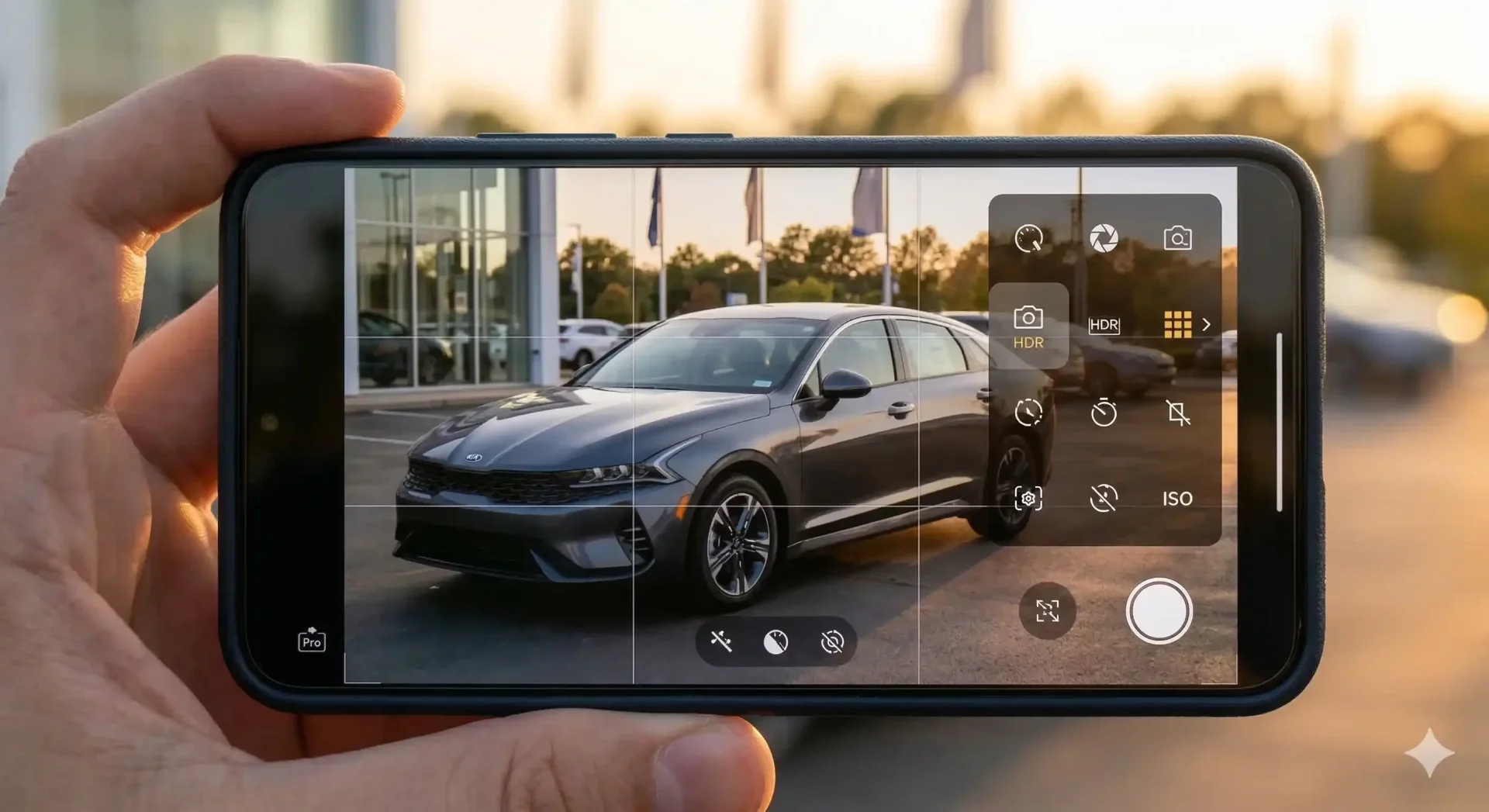
The best camera settings for car photography are not complicated, but they make a measurable difference in listing quality. Two photos of the same vehicle, shot in the same location at the same time, can look dramatically different depending on whether HDR is enabled, whether the resolution is maxed out, and whether the photographer used flash (never do). This guide covers the exact settings for car photography on phones and dedicated cameras, which equipment matters and which does not, and how to lock in a repeatable setup so every staff member produces consistent results.
We will start with the settings that make the biggest impact, then cover camera and lens recommendations for dealers who want to go beyond a phone.
Best camera settings for car photography on smartphones
Most dealer inventory photos are shot on phones, and that is fine. Modern smartphones produce images that meet every major marketplace listing standard. The key is configuring the camera app correctly before you start shooting.
Setting | Recommended value | Why it matters |
|---|---|---|
Mode | HDR (auto or always on) | Balances bright sky and dark underbody in one shot. This is the single most impactful setting. |
Resolution | Maximum (12MP+) | Preserves detail for cropping and AI post-processing. Never reduce to save storage. |
Flash | Off (always) | Flash creates harsh white reflections on paint, glass, and chrome. Natural light is always better. |
Aspect ratio | 4:3 (default) or 16:9 | 4:3 captures the most pixels. 16:9 matches widescreen display but crops the sensor. |
Digital zoom | None (1x only) | Digital zoom degrades image quality. Walk closer instead. |
Grid overlay | On | Helps keep the horizon level. Crooked photos look unprofessional. |
Timer | 2-second delay (optional) | Prevents camera shake when tapping the shutter. Useful for steady shots. |
HDR mode deserves extra emphasis. On a sunny lot, the roof and hood are blinding while the wheel wells and underbody are in deep shadow. Without HDR, you either blow out the highlights or lose the shadows. HDR captures multiple exposures and merges them, giving you usable detail in both. If your phone has HDR, turn it on and leave it on for all inventory shooting.
Car photography settings for DSLR and mirrorless cameras
If your dealership uses a dedicated camera, these settings for car photography produce the best results for inventory photos.
Setting | Recommended value | Why |
|---|---|---|
Mode | Aperture priority (A or Av) | You control depth of field, camera handles shutter speed |
Aperture | f/5.6 to f/8 | Sharp from bumper to bumper. Wider apertures blur the rear of the car. |
ISO | 100-400 (auto ISO with 800 ceiling) | Low ISO minimizes noise. Auto with a ceiling prevents grainy images on cloudy days. |
White balance | Auto or Daylight | Auto handles mixed lighting well. Daylight preset is more consistent across the day. |
Focus mode | Single-point AF on the front headlight | Ensures the front of the car is sharp. Multi-point AF can hunt between car and background. |
File format | Large JPEG or RAW+JPEG | JPEG for immediate upload. RAW if you plan detailed post-processing. |
Image stabilization | On (for handheld) | Reduces blur, especially at slower shutter speeds on cloudy days. |
Aperture priority mode at f/5.6-f/8 is the sweet spot for inventory photography. It keeps the entire vehicle in focus (unlike f/2.8 which blurs the rear) while maintaining a fast enough shutter speed to shoot handheld in daylight. Let the camera handle shutter speed and focus your attention on composition and angles.
Best camera for car photography at dealerships
The best camera for car photography is the one your team will actually use consistently. For most dealerships, that means a phone. Here is a realistic tiered recommendation.
Tier 1: smartphone (recommended for most dealers)
Any iPhone 13+ or Samsung Galaxy S21+ produces listing-quality images at 12MP. The advantages are significant: every staff member already has one, there is no learning curve, and photos transfer instantly to editing and listing tools. Add a $15-20 polarizing filter clip-on to reduce glare on paint and glass, and you have a setup that handles 90% of inventory photography needs.
Tier 2: entry-level mirrorless or DSLR ($500-800)
A dedicated car photography camera like the Canon EOS R50, Nikon Z30, or Sony A6100 offers better dynamic range, faster autofocus, and interchangeable lenses. These are worth the investment if you have a trained photographer on staff or if you sell premium inventory where image quality is a competitive differentiator.
Tier 3: professional mirrorless ($1,500+)
Full-frame cameras like the Sony A7 III, Canon R6, or Nikon Z6 III deliver the highest image quality but are overkill for marketplace listings. The improvement over a good phone or entry-level mirrorless is visible only in large prints and editorial contexts. Reserve this tier for studios and marketing campaigns, not daily inventory.
Best lens car photography: which focal length works
If you use a camera with interchangeable lenses, the best lens car photography starts with one versatile option.
A 35-70mm zoom (or kit lens equivalent) covers everything you need for inventory photography. At 35mm, you can capture the full vehicle from a reasonable distance. At 50-70mm, you can shoot detail close-ups without wide-angle distortion.
Avoid ultra-wide lenses (under 24mm) for standard inventory shots. They stretch the vehicle proportions and make the front end look oversized relative to the rear. Wide-angle distortion is the most common equipment-related quality problem in dealer photography.
A 50mm prime lens is the classic choice for automotive photography. It produces natural-looking proportions with no distortion and is typically sharper than a zoom at the same focal length. If you can only buy one lens, a 50mm f/1.8 (under $200 for most brands) is the best value in car photography.
For interior shots, a wider lens (24-35mm) helps capture the full dashboard and cabin in tight spaces. Switch to your phone if the camera lens cannot go wide enough inside the vehicle.
Setting up a repeatable car photography camera workflow
The best settings in the world do not help if they change every day. Lock your car photography settings into a repeatable process.
If using a phone, create a quick-reference card with the exact settings: HDR on, flash off, maximum resolution, grid on. Tape it to the phone case or include it in the shooting SOP. If using a dedicated camera, save your preferred settings to a custom mode (User 1 or C1 on most cameras). This lets any staff member turn on the camera, dial to C1, and shoot with the correct settings instantly.
Test your settings once per season. The light at your lot changes as the sun angle shifts throughout the year. A car photography settings profile that works perfectly in June may underexpose in December. A quick 10-minute test at the start of each season catches these shifts before they affect your listings.
Regardless of camera choice, AI post-processing normalizes lighting and color across your entire inventory, compensating for the variations that even good settings cannot fully prevent when shooting outdoors. The best results come from combining proper in-camera settings with AI enhancement: good input produces excellent output.
Final thoughts
The best camera settings for car photography are simple: HDR on, flash off, maximum resolution, and a level horizon. Whether you shoot on a phone or a mirrorless camera, these fundamentals produce listing-ready images that AI post-processing can turn into a professional catalog. Lock your settings into a repeatable SOP, train your team once, and then try the free image enhancer on your next batch to see how good input plus AI enhancement delivers consistent results across every vehicle.
Frequently asked questions
What are the best camera settings for car photography on a phone?
Enable HDR mode, turn flash off, set resolution to maximum (12MP+), use 4:3 aspect ratio, enable the grid overlay for level horizons, and never use digital zoom. HDR is the single most impactful setting because it balances the bright and dark areas of outdoor vehicle photos in one exposure.
What is the best camera for car photography at a dealership?
For most dealerships, a modern smartphone (iPhone 13+ or Samsung Galaxy S21+) with a $20 polarizing filter is the best practical choice. Staff already own them, there is no learning curve, and photos transfer instantly. For dealers who want dedicated equipment, entry-level mirrorless cameras like the Canon EOS R50 or Sony A6100 ($500-800) offer better dynamic range and interchangeable lenses.
What aperture should I use for car photography settings on a DSLR?
Use f/5.6 to f/8 in aperture priority mode. This range keeps the entire vehicle in sharp focus from bumper to bumper. Wider apertures (f/2.8-f/4) create a shallow depth of field that blurs the rear of the car, which looks artistic but is not ideal for inventory listings where buyers want to see the whole vehicle clearly.
What is the best lens car photography option for dealer inventory?
A 50mm prime lens (under $200 for most brands) is the best single-lens choice. It produces natural proportions without wide-angle distortion. For a versatile option, a 35-70mm zoom covers both full-vehicle shots and detail close-ups. Avoid ultra-wide lenses (under 24mm) for standard inventory as they distort vehicle proportions.
Should I shoot in RAW or JPEG for car photography?
JPEG is sufficient for most dealer inventory photography, especially if you use AI post-processing for backgrounds and lighting. RAW files offer more editing flexibility but are much larger and require dedicated software to process. If storage and workflow speed matter (they usually do at dealerships), shoot Large JPEG and let AI handle the enhancement.
How do I keep car photography settings consistent across multiple staff?
For phones, create a laminated quick-reference card with the exact settings and include it in the shooting SOP. For dedicated cameras, save your preferred settings to a custom mode (C1/User1) so any staff member can dial to the preset and shoot correctly. Test settings once per season to account for changing sun angles and lighting conditions.
75 E 3rd street, Sheridan, WY, 82801, USA
