How Automotive Marketing Agencies Scale Car Background Editing for Multiple Dealer Clients
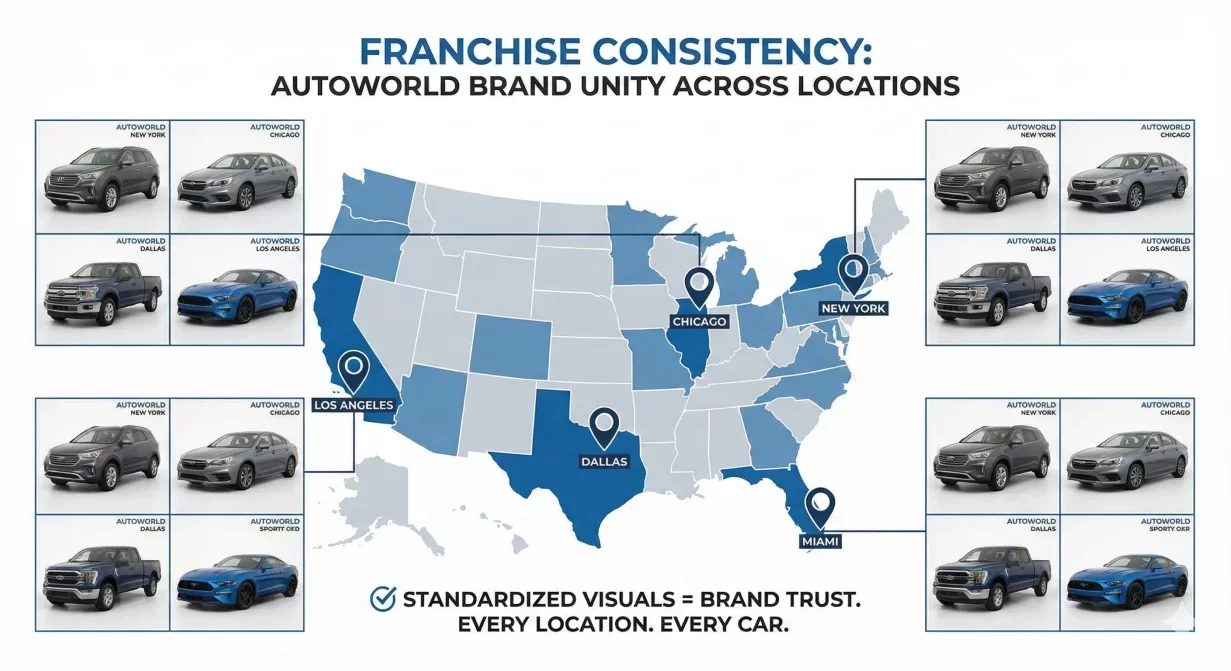
Automotive marketing agencies face a unique scaling challenge with car car background editing. Each dealer client has different visual standards, branding requirements, and volume expectations. Scaling profitably requires systems that handle this complexity without proportional cost increases.
This guide provides the operational framework agencies need to serve multiple dealer clients efficiently while maintaining quality and margins.
The agency photo editing challenge
Agencies serving dealers inherit photo operations that dealers themselves struggle to manage. The challenges multiply when serving multiple clients simultaneously.
- Variable standards: each client may have different background preferences, branding elements, and quality expectations.
- Inconsistent inputs: photo quality varies across clients based on their capture capabilities.
- Volume fluctuations: client inventory turnover varies seasonally and unpredictably.
- Margin pressure: competitive pricing and scope creep erode margins if operations do not scale efficiently.
Client-specific configuration
Serving multiple clients requires systematic separation of their requirements while sharing operational infrastructure.
Client template libraries
Create and maintain separate template configurations for each client. These templates encode client-specific requirements:
- background style and specific settings
- brand color integration if applicable
- enhancement levels matching client preferences
- export specifications for their platforms
Client documentation
Maintain documentation for each client covering:
- visual standards and quality criteria
- common issues and their solutions
- contact protocols and escalation paths
- contractual requirements affecting processing
Naming and organization conventions
Implement file naming and organization that prevents client confusion:
- client identifiers in file naming
- separated storage by client
- clear handoff procedures between clients
- audit trails for accountability
Operational model options
Agencies structure their photo editing operations in different ways. Dedicated teams per client develop deep client knowledge. Pooled operations maximize flexibility and capacity utilization. Hybrid approaches balance relationship depth with operational flexibility.
Most agencies find the hybrid approach adapts best to varied client mix and volume patterns.
Scaling profitably
Profitability at scale requires operational efficiency that keeps costs from growing linearly with volume.
Automation investment
Every manual step repeated across clients is a scaling tax. Invest in:
- batch processing that handles multiple photos simultaneously
- template application that eliminates per-photo decisions
- automated export formatting for client platforms
- integrated delivery to client systems where possible
Pricing that reflects reality
Price photo editing services based on actual operational cost plus margin.
- Volume tiers that reward larger clients while protecting margin.
- Complexity adjustments for clients with unusual requirements.
- Source quality considerations for clients providing poor inputs.
- Rush pricing for expedited turnaround.
Scope management
Scope creep is profitability's enemy. Define clearly what is included in photo editing services:
- number of photos per vehicle included
- turnaround time commitments
- revision limits and additional revision pricing
- what constitutes acceptable source photo quality
Quality management across clients
Maintaining quality while scaling requires systematic quality management rather than individual vigilance. Apply standardized quality checks to all client work. Implement sample-based auditing that catches systematic issues. Systematize client feedback collection and response.
Technology stack for multi-client operations
Your core processing platform should support:
- multiple template configurations for different clients
- batch processing at scale
- consistent output quality regardless of input variance
- export flexibility for varied platform requirements
How Car Background AI supports agency operations
Car Background AI provides the template flexibility and batch processing capabilities agencies need for multi-client operations. Configure different templates for different clients while processing on shared infrastructure.
The platform's consistent output quality across varied inputs reduces the quality management burden that would otherwise grow with client count.
Final thoughts
Scaling car photo editing across multiple dealer clients requires systematic operations: client-specific configurations, efficient operational models, profitability-conscious pricing, scalable quality management, and appropriate technology. Implement Car Background AI as the processing foundation for your multi-client agency operations.
Frequently asked questions
How many dealer clients can one agency team member support?
Capacity depends on client volume and complexity. With efficient tools and documented procedures, one team member might handle photo editing for five to ten smaller dealer clients or two to three high-volume clients.
Should I charge per photo or per vehicle?
Per-vehicle pricing is simpler for clients to understand and predict. It also incentivizes efficient capture by clients since additional photos do not cost extra.
How do I handle clients with poor source photo quality?
Define minimum acceptable source quality in your contract. Photos below that standard either return for recapture or require additional processing time that should be priced accordingly.
What turnaround time should I promise?
Standard turnaround of twenty-four to forty-eight hours is typical for dealer photo editing. Rush service at premium pricing handles urgent needs.
How do I prevent mixing up client work?
Implement strict naming conventions with client identifiers, separated storage structures, and clear handoff procedures. Systematic organization prevents embarrassing errors.

Tamas Magda
Co-founder, Growth and Partnerships at Car Background AI
Tamas Magda is co-founder of Car Background AI (carbackground.ai, CarBG), an AI car photo editor that replaces backgrounds on dealership inventory photos. He leads partnerships, growth, and business architecture, working with the development team on the product roadmap and with dealers on what their online listings actually need. He brings a background in venture building across APAC and MENA, and writes about vehicle merchandising, dealer photo workflows, and using AI on listing images without altering the car itself.
Tamas is a co-founder of Car Background AI and has a financial interest in the company. Articles that mention Car Background AI reflect that relationship.