Automotive Photography Has Become an Operations Problem: What Dealers Must Change
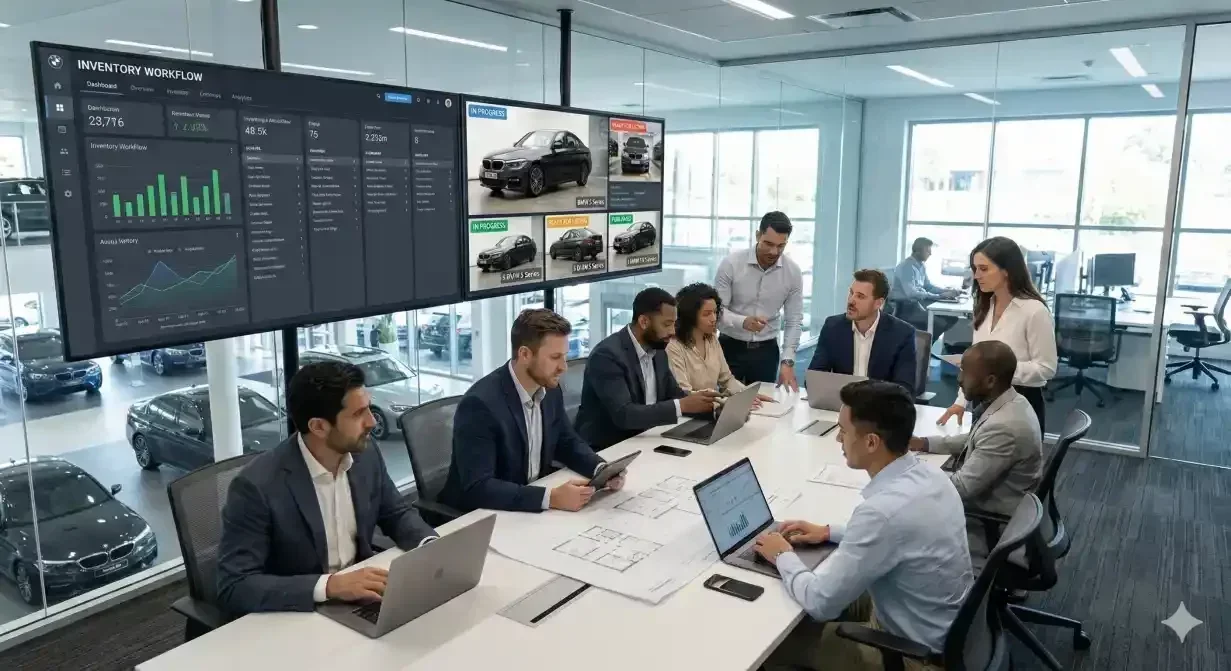
Automotive photography at dealerships has undergone a fundamental shift that many dealers have not yet recognized. The activity that once resembled an occasional art project now functions as critical operational infrastructure. This shift demands corresponding changes in how dealers approach, resource, and manage their photo workflows.
Understanding this transition helps dealers invest appropriately in the systems, tools, and processes that modern automotive retail requires.
The old model: photography as creative task
For decades, dealer photography operated as a creative undertaking. A skilled person with artistic sensibility would photograph vehicles when time permitted. Quality meant artistic quality: interesting angles, dramatic lighting, compelling composition. The goal was a beautiful image that might appear in an advertisement or showroom display.
This model made sense when photos appeared occasionally in print ads or dealer literature. Volume was low. Time pressure was manageable. Individual attention to each vehicle was feasible. The person who photographed might also choose which vehicles to feature and how to present them.
The model worked because expectations matched capabilities. When buyers primarily evaluated vehicles in person, photos played a supporting role. Adequate representation sufficed. Exceptional photos were nice but not necessary.
What changed: digital-first discovery
The rise of online marketplaces and digital-first buyer journeys transformed photography from supporting content to primary sales infrastructure.
Photos now carry full evaluation load
Buyers increasingly form opinions before visiting dealerships. In many cases, buyers make shortlists without ever seeing a vehicle in person. Photos are not supporting material; they are the primary evaluation medium. What buyers see in photos determines whether they ever see the vehicle in person.
Every vehicle needs photos immediately
Marketplace algorithms favor fresh listings. Vehicles without photos are invisible to search-driven buyers. The competitive window begins when a vehicle arrives on your lot. Every day without photos is a day without competitive visibility.
Volume exceeds what artisan models handle
A dealer receiving fifty trade-ins monthly cannot treat each as an individual creative project. The math does not work. Artisan photography might handle five vehicles well; it cannot scale to fifty without either dramatic quality reduction or proportional cost increase.
Consistency matters more than peak quality
In the old model, a few exceptional photos could represent the dealership. In the new model, buyers see your entire inventory. Inconsistency across that inventory is immediately visible. One beautiful photo alongside twelve mediocre ones damages perception more than twelve consistently acceptable photos.
The new model: photography as operations
Modern automotive photography succeeds when approached as an operational system rather than a creative task. This shift requires fundamental changes in perspective and practice.
From individual excellence to system reliability
Operations succeed through reliable repetition, not occasional brilliance. The goal shifts from taking a great photo to processing every vehicle consistently. Reliability across volume matters more than excellence on any single image.
This does not mean quality does not matter. It means quality must be systematized rather than dependent on individual effort or inspiration.
From skill-dependent to process-dependent
Artisan models depend on skilled individuals. Their absence creates gaps. Their departure creates crises. Operational models depend on documented processes and appropriate tools. People execute processes; processes remain when people change.
When photography becomes operations, any trained person can execute the workflow. Knowledge lives in documentation and tooling, not individual expertise.
From time-available to time-constrained
Creative work expands to fill available time. Operations work within time budgets. Each vehicle receives its allocated time, produces acceptable results, and moves to the next. Time-constrained processing forces efficiency and discourages over-optimization.
From subjective quality to measured standards
Artisan quality is judged subjectively: does this photo look good to me? Operational quality is measured against standards: does this photo meet documented criteria? Standards enable consistent evaluation regardless of who reviews. Subjectivity introduces variation that operations cannot tolerate.
What this shift requires from dealers
Embracing photography as operations demands specific changes from dealership management.
Investment in appropriate tools
Artisan work can use whatever tools the artisan prefers. Operational work requires tools designed for operational outcomes: speed, consistency, reliability at scale. Tools that excel for individual creative work may fail at operational volume. Select tools based on operational criteria.
This often means shifting from general-purpose photo editing software to purpose-built automotive processing platforms. The features that make creative tools powerful may be exactly what makes them slow for production work.
Documentation of standards and processes
Operations require documentation that artisan work does not. Write down what acceptable photos look like. Document each workflow step. Create training materials that transfer knowledge without requiring individual mentorship.
Documentation feels bureaucratic but enables scale. Without it, every new person learns differently, and consistency is impossible.
Management attention and metrics
Artisan work is managed loosely: hire talented people and let them create. Operational work requires active management: measure throughput, track quality, identify bottlenecks, drive continuous improvement.
Photography deserves management attention proportional to its business impact. In digital-first retail, that impact is substantial. Neglected photo operations become competitive liabilities.
Organizational recognition
Photography is often organizationally orphaned, assigned wherever convenient rather than where it fits strategically. Operations-critical photography deserves clear organizational ownership with appropriate authority and resources.
Whether photography lives in sales, marketing, or operations matters less than whether it lives somewhere with accountability for operational outcomes.
Signs you are still operating the old model
Dealers can assess whether they have made the operational transition by checking for these indicators:
- Single person dependency: If one person's absence stops photography, you have an artisan model, not an operational system.
- Variable time-to-listing: If some vehicles publish in hours while others take days with no clear reason, process is not controlling outcomes.
- Quality variation: If browsing your inventory shows visibly inconsistent photo quality, you lack enforced standards.
- No metrics: If you cannot state your average time-to-listing, rework rate, or photos processed per hour, you are not managing operations.
- Creative justifications: If requests for faster throughput are met with "quality takes time" without specific constraint identification, artisan mindset persists.
The competitive consequence
Dealers who make the operational shift gain compounding advantages over those who do not.
Faster time-to-listing means more days of marketplace visibility per vehicle. Consistent quality builds buyer trust that transfers across inventory. Documented processes survive staff turnover. Measured performance enables continuous improvement.
Meanwhile, dealers stuck in artisan mode face growing disadvantage. Their photos are slow, inconsistent, and dependent on individuals who may leave. As buyer expectations rise and competitor capabilities improve, the gap widens.
The competitive future belongs to dealers who treat photography as the operational infrastructure it has become.
How Car Background AI enables the operational model
Car Background AI is designed for operational photography outcomes: consistent results at scale through template-based batch processing. The platform makes operational workflow possible without requiring operational photography expertise.
For dealers transitioning from artisan to operational models, Car Background AI provides the tooling that makes documentation meaningful and standards enforceable. Photography becomes what operations requires: reliable, measurable, and improvable.
Final thoughts
Automotive photography has shifted from creative task to operational infrastructure. This shift demands corresponding changes in tools, processes, documentation, and management attention. Dealers who recognize and respond to this shift build competitive advantage; those who do not fall progressively behind. The question is not whether to make the transition but how quickly you can complete it. Contact Car Background AI to discuss how operational photography fits your competitive strategy.
Frequently asked questions
Does treating photography as operations mean quality does not matter?
No. Quality matters tremendously. Operations means systematizing quality rather than leaving it to individual discretion. Documented standards, appropriate tools, and verification processes ensure consistent quality at scale. Operations enables quality; it does not abandon it.
How do I transition from artisan to operational model?
Start by documenting current practices and measuring current performance. Identify bottlenecks and variation sources. Implement tools that enable consistency. Write standards that anyone can apply. Train multiple people on documented processes. Measure improvement and adjust.
What if my photographer resists operational changes?
Resistance often stems from perceived devaluation of expertise. Frame operations as enabling focus on what matters: the photographer's time goes toward improving the system rather than repetitive execution. Expertise guides process design; process handles routine work.
How much does operational photography infrastructure cost?
Far less than artisan photography at scale. Operational tools replace labor-intensive processes. Documentation prevents training redundancy. Metrics identify waste. The question is not cost but return: operational photography typically costs less while producing more.
Can small dealers benefit from operational approach?
Yes. Even dealers processing ten vehicles monthly benefit from documented standards, appropriate tools, and measured performance. The operational mindset scales down as well as up. Small dealers with operational processes outperform larger dealers with artisan chaos.
What is the biggest mistake in transitioning to operational photography?
Implementing tools without changing mindset. New tools used with old thinking produces marginal improvement. The shift is cultural as much as technical. Photography must be recognized, resourced, and managed as operations for operational tools to deliver operational results.

Tamas Magda
Co-founder, Growth and Partnerships at Car Background AI
Tamas Magda is co-founder of Car Background AI (carbackground.ai, CarBG), an AI car photo editor that replaces backgrounds on dealership inventory photos. He leads partnerships, growth, and business architecture, working with the development team on the product roadmap and with dealers on what their online listings actually need. He brings a background in venture building across APAC and MENA, and writes about vehicle merchandising, dealer photo workflows, and using AI on listing images without altering the car itself.
Tamas is a co-founder of Car Background AI and has a financial interest in the company. Articles that mention Car Background AI reflect that relationship.