Before and After Car Background Enhancement: What Good Processing Looks Like
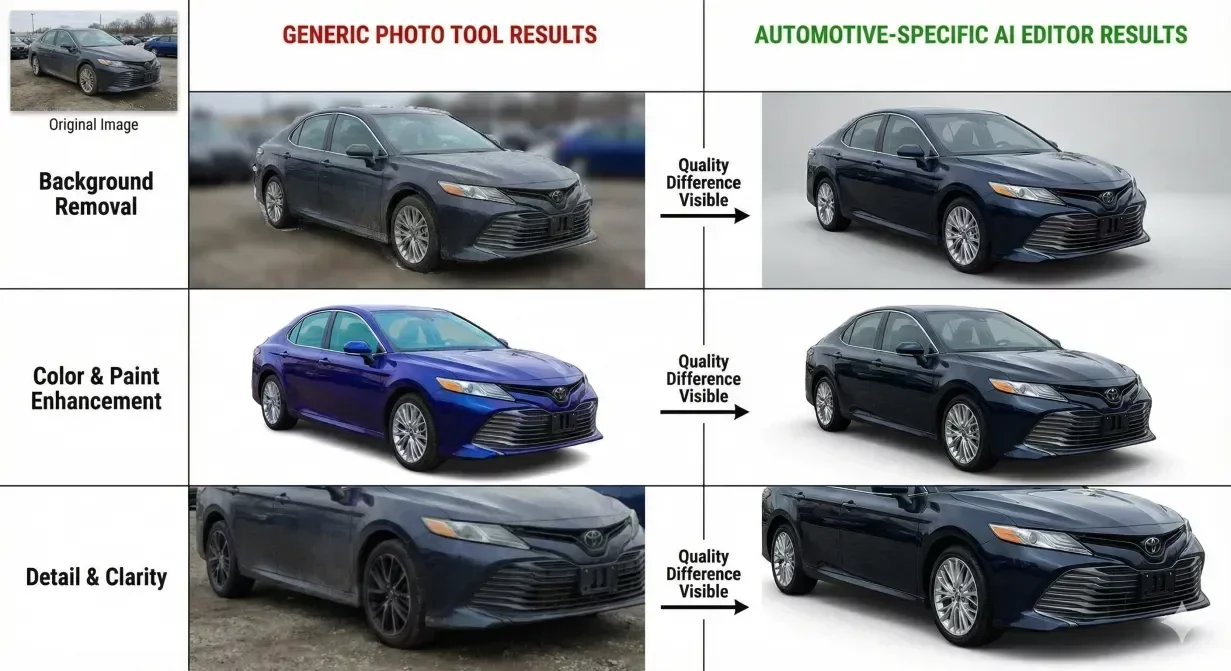
Understanding what good car photo enhancement looks like helps you evaluate your own results and set appropriate quality standards. Car background quality plays a critical role in this process. This guide describes common before/after scenarios, showing what proper enhancement achieves and what to avoid.
Lighting Enhancement Examples
Scenario: Dark Interior
Before: Dashboard and seats barely visible. Instrument cluster unreadable. Interior appears as dark cavity.
Good Enhancement: Dashboard controls clearly visible. Seat colors distinguishable. Instrument cluster readable. Interior feels inviting.
Over-Enhancement: Interior unnaturally bright. No shadows remain. HDR glow. Looks fake.
Scenario: Harsh Shadows
Before: Half the vehicle in sun, half in shadow. Extreme contrast with lost detail.
Good Enhancement: Both sides visible with detail. Natural dimensional appearance maintained.
Over-Enhancement: Completely flat lighting. All shadows eliminated. Looks like a rendering.
Color Enhancement Examples
Scenario: Color Cast
Before: Overall blue/cool tint or warm/orange cast. White elements appear tinted.
Good Enhancement: Neutral color balance. White is white. Paint color appears accurate.
Over-Enhancement: Overcorrected or neutral with unnatural saturation boost.
Scenario: Muted Colors
Before: Paint looks dull. Colors lack vibrancy.
Good Enhancement: Paint shows natural richness. Vehicle looks as good as reality.
Over-Enhancement: Paint glows unnaturally. Colors oversaturated.
Background Enhancement Examples
Scenario: Cluttered Lot
Before: Other vehicles visible. Lot signage in frame. Distracting elements.
Good Enhancement: Clean, consistent background. Vehicle is clear focus.
Poor Execution: Visible halos. Lighting mismatch. Floating appearance.
Edge Quality Examples
Scenario: Background Removal Edges
Good Enhancement: Clean edges. No halos. Mirrors and antennas intact. Natural transition.
Poor Enhancement: White halos. Jagged edges. Missing details. Color fringing.
Overall Quality Standards
Good Enhancement Achieves:
- Improved technical quality
- Professional presentation without obvious processing
- Accurate representation of actual vehicle
- Consistent treatment across set
- Natural appearance that builds trust
Over-Enhancement Creates:
- Artificial appearance that triggers skepticism
- Colors exceeding real-world possibility
- Visible processing artifacts
- Buyer disappointment upon seeing vehicle
How CarBG Delivers Good Enhancement
CarBG is calibrated for trust-safe results. Enhancement improves quality while maintaining natural appearance.
Processing is optimized for dealer-appropriate quality professional presentation that accurately represents vehicles.
Final Thoughts
Good car photo enhancement improves quality while maintaining accuracy and natural appearance. Use these scenarios as reference when evaluating results. Try CarBG to see trust-safe enhancement on your inventory.
The CarBG Angle (FAQ Bits)
How do I know if enhancement has gone too far?
Compare to the actual vehicle. If photos look significantly better than reality, enhancement is excessive.
Should enhanced photos look exactly like the original?
No. Good enhancement improves technical quality. Photos should look better than unprocessed originals but not better than the actual vehicle.
What if my source photos have serious problems?
Severe problems often require recapture rather than enhancement. Enhancement improves acceptable photos; it cannot rescue failed captures.
How consistent should enhancement be across inventory?
Very consistent. Variation in treatment makes editing obvious. All vehicles should receive similar treatment.
Do buyers notice over-enhanced photos?
Yes, even subconsciously. Trust erodes even when buyers cannot articulate what looks wrong.
What enhancement elements matter most?
Lighting/exposure has most visible impact. Background cleanliness follows. Color should be subtle.

Tamas Magda
Co-founder, Growth and Partnerships at Car Background AI
Tamas Magda is co-founder of Car Background AI (carbackground.ai, CarBG), an AI car photo editor that replaces backgrounds on dealership inventory photos. He leads partnerships, growth, and business architecture, working with the development team on the product roadmap and with dealers on what their online listings actually need. He brings a background in venture building across APAC and MENA, and writes about vehicle merchandising, dealer photo workflows, and using AI on listing images without altering the car itself.
Tamas is a co-founder of Car Background AI and has a financial interest in the company. Articles that mention Car Background AI reflect that relationship.