Car Dealership Photography: The Complete Guide
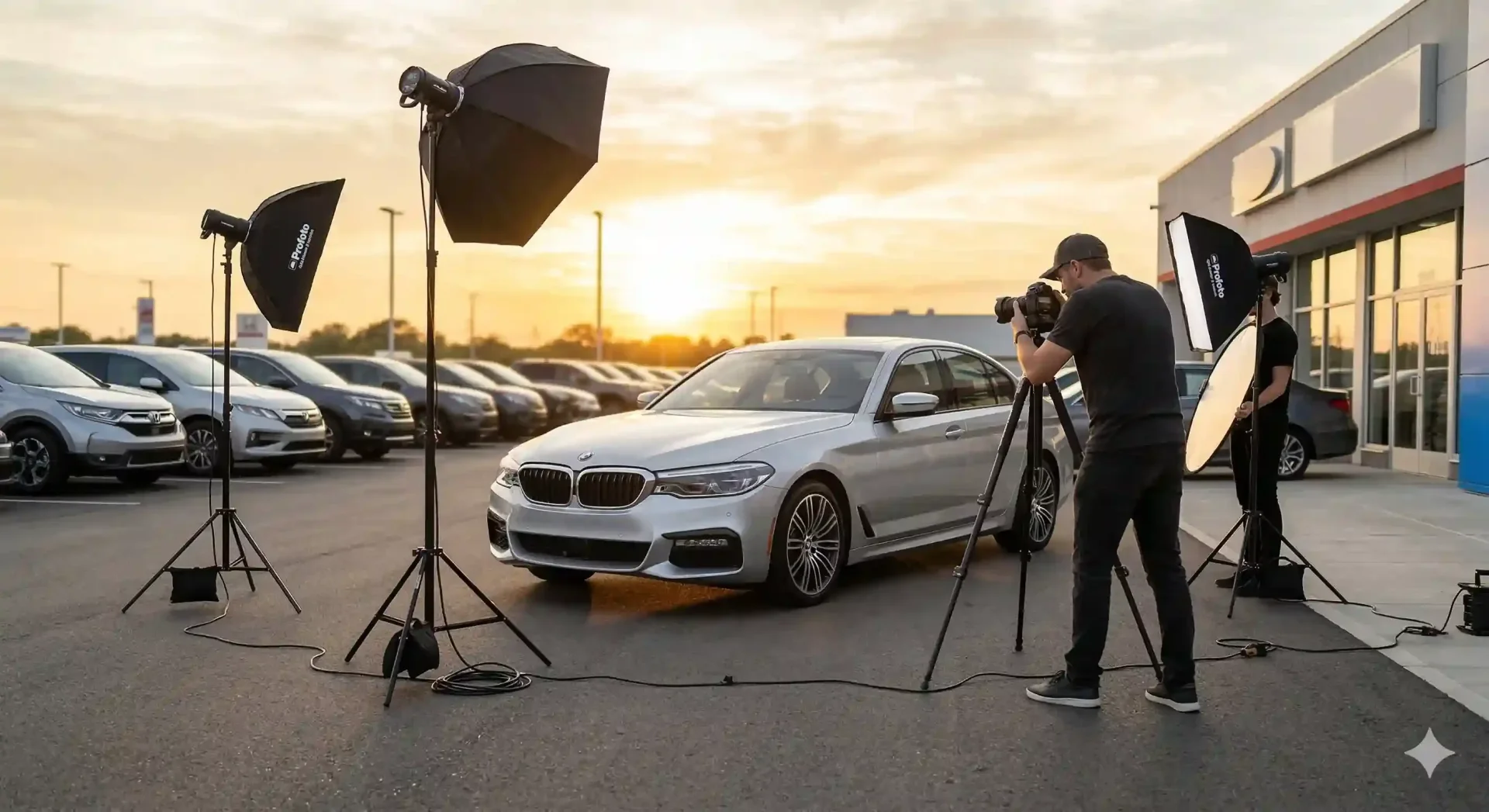
Car dealership photography is the practice of shooting and preparing a dealership's vehicle inventory for online listings so each car looks clean, consistent, and ready to buy. It covers the full workflow from capturing the shots to processing them, and CarBG handles the post-processing side by removing or replacing backgrounds so every listing shares one polished look. The result is inventory that reads as professional across Cars.com, CarGurus, AutoTrader, and Facebook Marketplace.
Car dealership photography is the single most controllable factor in how fast your inventory sells online. Every vehicle on your lot competes with hundreds of others on Cars.com, CarGurus, AutoTrader, and Facebook Marketplace. The listings with clean, consistent, well-lit photos earn more clicks, more inquiries, and faster sales. This guide covers everything a dealership needs to build a reliable photo operation, from equipment and shooting technique to AI-powered post-processing.
Why car dealership photography drives faster sales
Buyers make snap judgments. Research consistently shows that listings with professional-quality images receive significantly more engagement than those with dark, cluttered, or inconsistent photos. The connection is straightforward: a buyer scrolling past 50 listings stops on the one that looks trustworthy. Trust starts with the image.
From the dealer's side, better photography for car dealerships shortens the time between lot arrival and first inquiry. For dealers looking to attract more B2B clients - such as fleet buyers, wholesalers, or auction partners - that speed advantage compounds, because professional visuals signal operational credibility before the first conversation.
When a vehicle looks ready to buy in the photos, there is less back-and-forth about condition, fewer "can you send more pictures" requests, and faster scheduling of test drives.
The compounding effect matters too. Consistent dealership car photography across your entire inventory creates a brand impression. A buyer who sees 30 vehicles all photographed to the same standard perceives your operation as organized and credible, even before stepping on the lot.
Car dealership photography tips for consistent results
Consistency beats perfection in inventory photography. One stunning hero shot surrounded by 14 mediocre images hurts more than 15 uniformly good ones. Here are practical car dealership photography tips that any staff member can follow.
Shooting checklist for every vehicle
- Clean the vehicle thoroughly before shooting. Water spots, dust on the hood, and fingerprints on glass all show up in photos and cannot be fixed in post-processing without looking artificial.
- Shoot at the same time of day whenever possible. Early morning or late afternoon (golden hour) gives you soft, even lighting. Midday sun creates harsh shadows under the car and on the hood.
- Use the same sequence for every car: front three-quarter, rear three-quarter, driver side profile, passenger side profile, front straight-on, rear straight-on, interior dashboard, rear seats, trunk, odometer, VIN plate.
- Park the vehicle in the same designated spot on your lot. A consistent shooting location means consistent backgrounds, which makes post-processing much easier.
- Shoot at hip height, not eye level. A slightly lower angle makes the car look more substantial and appealing.
Setting up your car photography dealership workflow
The biggest operational challenge in dealership car photography is not the shooting itself. It is what happens after. Photos sit on someone's phone, get transferred to a laptop, wait for editing, and then eventually make it to the listing platform. That delay costs you leads.
A streamlined workflow looks like this:
- Vehicle arrives on lot and gets cleaned within 24 hours.
- Designated staff member shoots the full photo sequence (11 standard angles, under 10 minutes per car).
- Photos upload directly to your AI car photo editor via phone or desktop.
- AI processes backgrounds, lighting, and color in seconds.
- One person reviews the output for edge quality and color accuracy (30-second QA check per vehicle).
- Marketplace-ready files export and upload to your listing platforms.
Total time from shooting to live listing: under 30 minutes per vehicle, including the photo session. Compare that to the industry average of 2-5 days when editing is outsourced or handled manually.
Equipment and settings for photography for car dealerships
You do not need a professional camera to produce good dealership inventory photos. Most modern smartphones (iPhone 13+ or Samsung Galaxy S21+) shoot at 12MP or higher, which is more than sufficient for marketplace listings. What matters more than the camera is how you use it.
Setting | Recommendation | Why |
|---|---|---|
Mode | Auto or HDR | HDR balances bright sky and dark underbody in one shot |
Aspect ratio | 16:9 or 4:3 | Matches most marketplace display formats |
Resolution | 12MP minimum | Allows cropping without quality loss |
Flash | Off (always) | Flash creates harsh reflections on paint and glass |
Zoom | No digital zoom | Digital zoom degrades image quality |
Orientation | Landscape | Matches listing display, shows full vehicle profile |
If budget allows, a polarizing filter clip-on for your phone reduces reflections on glass and paint, giving you cleaner images straight out of the camera. This costs under $20 and makes a noticeable difference.
Common car photography for dealerships mistakes and fixes
Even dealerships with good intentions make these errors repeatedly.
Mistake 1: inconsistent backgrounds. Different staff shoot in different spots on the lot. One vehicle has a building behind it, the next has a dumpster. Fix: designate one "photo corner" on your lot with the cleanest background, or use AI background replacement to standardize everything after the fact.
Mistake 2: skipping interior shots. Exteriors get all the attention, but buyers use interior photos to gauge condition and comfort. Fix: always shoot the dashboard, rear seats, and trunk at minimum. Interior photos often drive the final purchase decision.
Mistake 3: shooting in harsh midday light. The noon sun creates deep shadows under the vehicle, hot spots on the roof, and squinting-inducing glare on the windshield. Fix: shoot before 10 AM or after 3 PM whenever possible. If midday is your only option, park the car in open shade.
Mistake 4: no quality gate before publishing. Photos go straight from the camera to the listing without anyone checking for blurry shots, wrong angles, or background clutter. Fix: one person spends 30 seconds per vehicle reviewing the set before upload. Catch the problems before buyers do.
Scaling dealership car photography with AI
For single-location dealers, a phone and good habits may be enough. For multi-location groups or high-volume operations, AI post-processing is what makes photography for car dealerships scalable.
AI tools handle the three most time-consuming post-production tasks: background replacement, lighting normalization, and color correction. When these happen automatically, your staff only needs to shoot and review. The editing layer, which traditionally required either a skilled designer or an external vendor, disappears from the workflow entirely.
The free car image enhancer approach lets you test this on your next vehicle intake without any commitment. Process one car's full photo set through the AI, compare against your manually edited images, and measure the time difference. Most dealers who make that comparison do not go back to manual editing for standard inventory.
Final thoughts
Car dealership photography is not about expensive equipment or artistic skill. It is about building a repeatable system that produces clean, consistent, trust-building images for every vehicle on your lot. Start with the shooting checklist, set up a designated photo spot, and standardize your post-processing. Once you have the foundation in place, try CarBG on your next intake batch to see how AI can compress your photo-to-listing timeline from days to minutes.
Frequently asked questions
Do I need a professional camera for car dealership photography?
No. Modern smartphones with 12MP or higher resolution produce images that meet marketplace listing standards. What matters more is consistent lighting, clean vehicles, and a standardized shooting sequence. A $20 polarizing filter clip-on for your phone can reduce glare and reflections, which is the single best low-cost upgrade available.
How many photos should I take per vehicle?
Aim for 11-15 photos per vehicle covering all standard angles: front three-quarter, rear three-quarter, both side profiles, front and rear straight-on, dashboard, rear seats, trunk, odometer, and VIN plate. More angles give buyers a complete picture and reduce "can you send more photos" requests that slow the sales process.
What is the best time of day for car photography dealership shoots?
Early morning or late afternoon, roughly 7-10 AM or 3-6 PM depending on season. These golden hour windows provide soft, even lighting that minimizes harsh shadows and hot spots on the paint. If you must shoot at midday, park the vehicle in open shade rather than direct sun to avoid extreme contrast.
How can I standardize photography for car dealerships across multiple locations?
Create a written SOP with the exact angle sequence, template assignments, and QA checklist. Distribute it to every location and train one designated photographer per site. Use an AI post-processing tool with locked templates so every location produces identical output regardless of who shoots or what the lot looks like.
How much does professional car dealership photography cost?
Outsourced professional photography typically runs $30-$100 per vehicle depending on the number of shots and turnaround time. AI-powered self-service tools reduce this to a per-image subscription cost, often under $1 per photo. The real savings come from eliminating turnaround delays and keeping your car photography for dealerships workflow entirely in-house.
What car dealership photography tips improve listing performance the most?
Three changes deliver the biggest impact. First, clean the vehicle thoroughly before shooting. Second, use consistent backgrounds across your entire inventory. Third, shoot at the same time of day for even lighting. These three practices alone can transform a scattered-looking inventory page into a professional catalog that builds buyer confidence immediately.

Tamas Magda
Co-founder, Growth and Partnerships at Car Background AI
Tamas Magda is co-founder of Car Background AI (carbackground.ai, CarBG), an AI car photo editor that replaces backgrounds on dealership inventory photos. He leads partnerships, growth, and business architecture, working with the development team on the product roadmap and with dealers on what their online listings actually need. He brings a background in venture building across APAC and MENA, and writes about vehicle merchandising, dealer photo workflows, and using AI on listing images without altering the car itself.
Tamas is a co-founder of Car Background AI and has a financial interest in the company. Articles that mention Car Background AI reflect that relationship.