Physical Car Photo Booth vs Software Solutions: Which Approach Fits Your Dealership
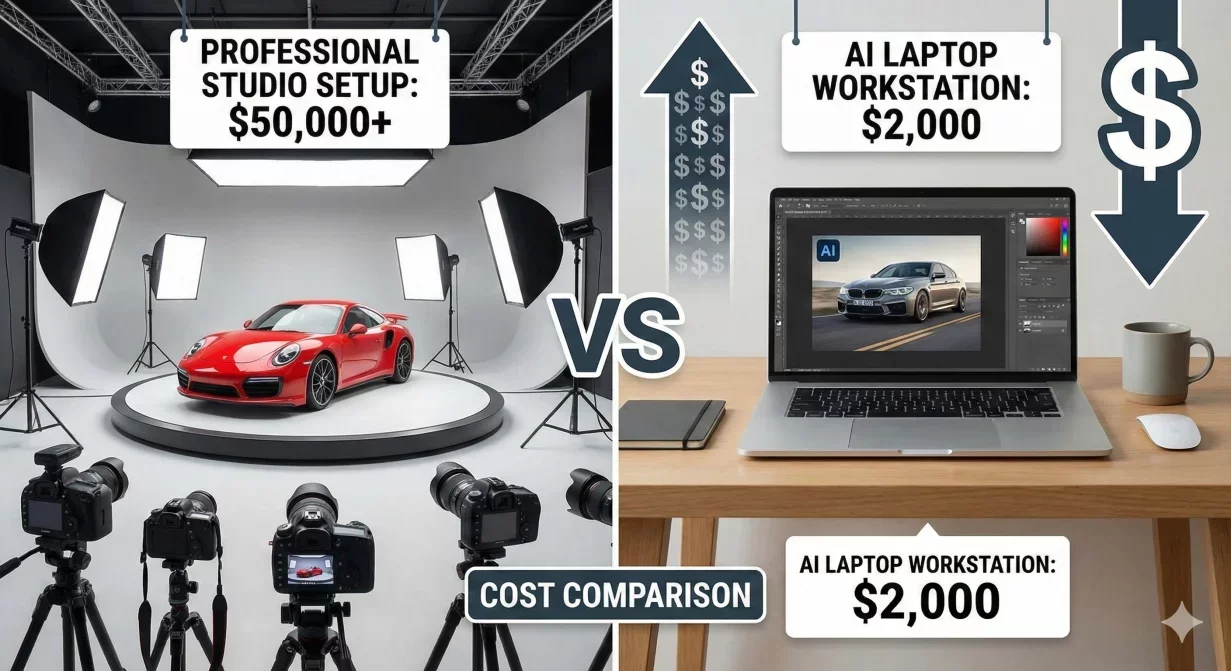
A car photo booth and software-based processing represent fundamentally different approaches to professional vehicle photography. Photo booths create controlled capture environments; software transforms standard captures into professional outputs. This comparison helps dealers evaluate which approach fits their specific operational context.
The decision involves trade-offs across investment, space, workflow, and long-term flexibility. Understanding these trade-offs leads to better infrastructure choices.
What Car Photo Booths Actually Provide
Car photo booths are physical enclosures or open structures designed to control the photography environment. They range from simple backdrop systems to sophisticated automated installations.
Types of Photo Booth Systems
Backdrop systems: The simplest category provides professional background materials without lighting control. Vehicles drive in front of the backdrop for capture. Cost: two thousand to eight thousand dollars.
Lighting-integrated booths: These add controlled lighting to backdrop systems. Consistent illumination regardless of time or weather produces more predictable captures. Cost: fifteen thousand to thirty thousand dollars.
Automated capture systems: Advanced booths include cameras, lighting, turntables, and software integration. Some automate the entire capture process with minimal operator involvement. Cost: thirty thousand to one hundred thousand dollars or more.
What Booths Do Well
Environmental control: Consistent lighting and background regardless of weather, time of day, or outdoor conditions. Results are predictable because inputs are controlled.
Motion capture: Turntable systems can capture 360-degree spins or video that software cannot create from static photos. However, if you only have still images, you can use AI tools to create a video with simple animations and transitions, even though the result won't match the realism of a true 360-degree turntable capture.
Immediate results: What you capture is close to final output with minimal processing required.
What Booths Require
Space: Minimum six hundred square feet of dedicated area, often more for automated systems with approach lanes.
Capital: Significant upfront investment that must be justified against alternative uses of funds.
Infrastructure: Electrical capacity, possibly climate control, and maintenance access.
Vehicle handling: Every vehicle must be driven to the booth location, photographed, and returned to its parking spot.
What Software Solutions Actually Provide
Software-based solutions process photos captured anywhere into professional-quality outputs. They transform rather than control.
Types of Software Approaches
Background replacement: AI removes original backgrounds and substitutes clean, consistent scenes. Turns lot photos into studio-style images.
Enhancement processing: Lighting optimization, color correction, and quality improvements address capture variability.
Batch automation: Complete vehicle photo sets process simultaneously with consistent treatment.
What Software Does Well
Flexibility: Capture anywhere on your lot. No vehicle transport required. Process from any location with internet.
Scalability: Costs scale with volume. No capacity ceiling from physical infrastructure. Multiple capture teams can work simultaneously.
Template variety: Change background styles instantly without physical changes. Test different approaches without investment.
Enhancement capabilities: Software can improve poor captures in ways physical environments cannot. Lighting optimization rescues mixed-condition photos.
What Software Requires
Acceptable source photos: Software enhances but cannot create information that was not captured. Minimum capture quality standards apply.
Processing time: Transformation adds a step between capture and final output.
Internet connectivity: Cloud-based processing needs reasonable upload capability.
Ongoing subscription: Costs continue as long as you use the service rather than being amortized from capital investment.
Operational Workflow Comparison
The day-to-day experience of each approach differs significantly.
Photo Booth Workflow
- Identify vehicles needing photos
- Drive vehicle to booth location
- Position in booth, adjust as needed
- Capture photo sequence
- Drive vehicle back to parking
- Export photos to listing system
Time per vehicle: Twenty to forty minutes including transport
Bottleneck: Single booth limits throughput; vehicles queue during busy periods
Software Solution Workflow
- Identify vehicles needing photos
- Walk to vehicle and capture photos on lot
- Upload photos to processing platform
- Apply template and process batch
- Review, export, and publish
Time per vehicle: Ten to twenty minutes total
Bottleneck: None inherent; multiple people can capture simultaneously
Workflow Impact Assessment
For low volume dealers processing five to ten vehicles weekly, workflow differences are manageable either way. For higher volume operations processing dozens of vehicles daily, software workflow advantages compound significantly.
Consider seasonal variations. If your volume spikes during certain periods, booth capacity creates hard ceilings while software scales smoothly.
Quality Assessment
Both approaches produce professional results through different mechanisms.
Booth Quality Characteristics
Controlled capture eliminates variability at the source. Every photo benefits from identical lighting and background. No compositing artifacts since backgrounds are physically real.
However, booth quality depends on booth maintenance. Dirty backgrounds, burnt-out lights, or calibration drift degrade results until addressed.
Software Quality Characteristics
Processing standardizes varied inputs into consistent outputs. Every photo receives identical background and enhancement treatment regardless of capture conditions.
However, software quality depends on capture quality. Poor source photos limit output quality regardless of processing sophistication.
Quality Bottom Line
Professional marketplace listings are achievable with either approach. Booth quality ceiling is slightly higher for maximum-control situations; software quality floor is higher for accommodating varied capture conditions.
Financial Comparison Framework
Build your own comparison using these cost categories.
Photo Booth Costs
- Equipment purchase: $15,000-$100,000+
- Installation: $2,000-$10,000
- Space allocation: $X per square foot opportunity cost
- Electrical/infrastructure: $1,000-$5,000
- Annual maintenance: 1-3% of equipment cost
- Staff time for vehicle transport: significant
Software Costs
- Monthly subscription: $50-$300 typical
- Per-image pricing: $0.10-$1.00 where applicable
- No space cost
- No infrastructure cost
- No maintenance
- Minimal staff time for processing
Breakeven Analysis
Calculate your specific breakeven point. If booth costs $30,000 and software costs $200 monthly, you need 150 months (12+ years) for booth to break even on direct costs alone, not counting space, maintenance, and staff time.
For most dealers, software achieves better lifetime economics unless 360-degree capture or specific booth features are genuinely required.
Decision Criteria Summary
Photo booth makes sense when:
- You specifically need 360-degree or video capture
- You have available space with low opportunity cost
- Capital is easier to justify than ongoing operational expense
- Volume is very high and consistent year-round
- Maximum capture control matters more than flexibility
Software makes sense when:
- Space is limited or has high opportunity cost
- You prefer predictable operational expense
- Volume varies and you want costs to scale accordingly
- Flexibility to change visual approach matters
- Vehicle transport logistics are challenging
- You want to start immediately without construction delays
How CarBG Represents the Software Approach
CarBG provides the background replacement, lighting optimization, and batch processing capabilities that make software solutions effective for dealer workflows. The platform handles automotive-specific processing challenges that generic tools struggle with.
For dealers evaluating software alternatives to physical booth investment, CarBG offers the professional output quality, operational flexibility, and cost efficiency that make software compelling.
Final Thoughts
Car photo booths and software solutions both produce professional vehicle images, but their investment, operational, and flexibility characteristics differ fundamentally. Most dealers find software delivers better overall economics with comparable quality for standard listing needs. Booths retain advantages for specific capabilities like 360-degree capture or maximum environmental control. Contact CarBG to discuss which approach fits your dealership's specific situation.
Frequently Asked Questions(FAQs)
Is a car photo booth worth the investment?
For most dealers, no. The capital cost, space requirements, and operational overhead outweigh quality advantages over software alternatives. Booths make sense for very high volume operations specifically needing 360-degree capture or dealers with available space and preference for capital over operating expense.
Can software really match photo booth quality?
For standard marketplace listings, yes. Software-processed photos are indistinguishable from booth photos in typical listing contexts. Booths offer marginally more controlled capture, but software enhancement addresses most capture variability effectively.
How much space does a photo booth need?
Minimum six hundred square feet for basic systems, up to fifteen hundred square feet for automated booths with approach areas. This dedicated space cannot serve other purposes during operation.
What is the main advantage of software over booths?
Operational flexibility. No vehicle transport, no capacity ceiling, no dedicated space requirement, and costs that scale with actual usage. Software fits into existing workflows rather than requiring workflows to fit around physical infrastructure.
What is the main advantage of booths over software?
Environmental control and 360-degree capture capability. Booths eliminate outdoor variability at the source and enable motion capture that software cannot replicate from static photos.
Can I switch from booth to software or vice versa?
Switching from booth to software is easy since software requires no infrastructure. Switching from software to booth requires full booth investment and installation. Consider long-term flexibility when making initial choice.

Tamas Magda
Co-founder, Growth and Partnerships at Car Background AI
Tamas Magda is co-founder of Car Background AI (carbackground.ai, CarBG), an AI car photo editor that replaces backgrounds on dealership inventory photos. He leads partnerships, growth, and business architecture, working with the development team on the product roadmap and with dealers on what their online listings actually need. He brings a background in venture building across APAC and MENA, and writes about vehicle merchandising, dealer photo workflows, and using AI on listing images without altering the car itself.
Tamas is a co-founder of Car Background AI and has a financial interest in the company. Articles that mention Car Background AI reflect that relationship.