Car Photoshoot: Every Type From Lot Shoots to Studio Setups
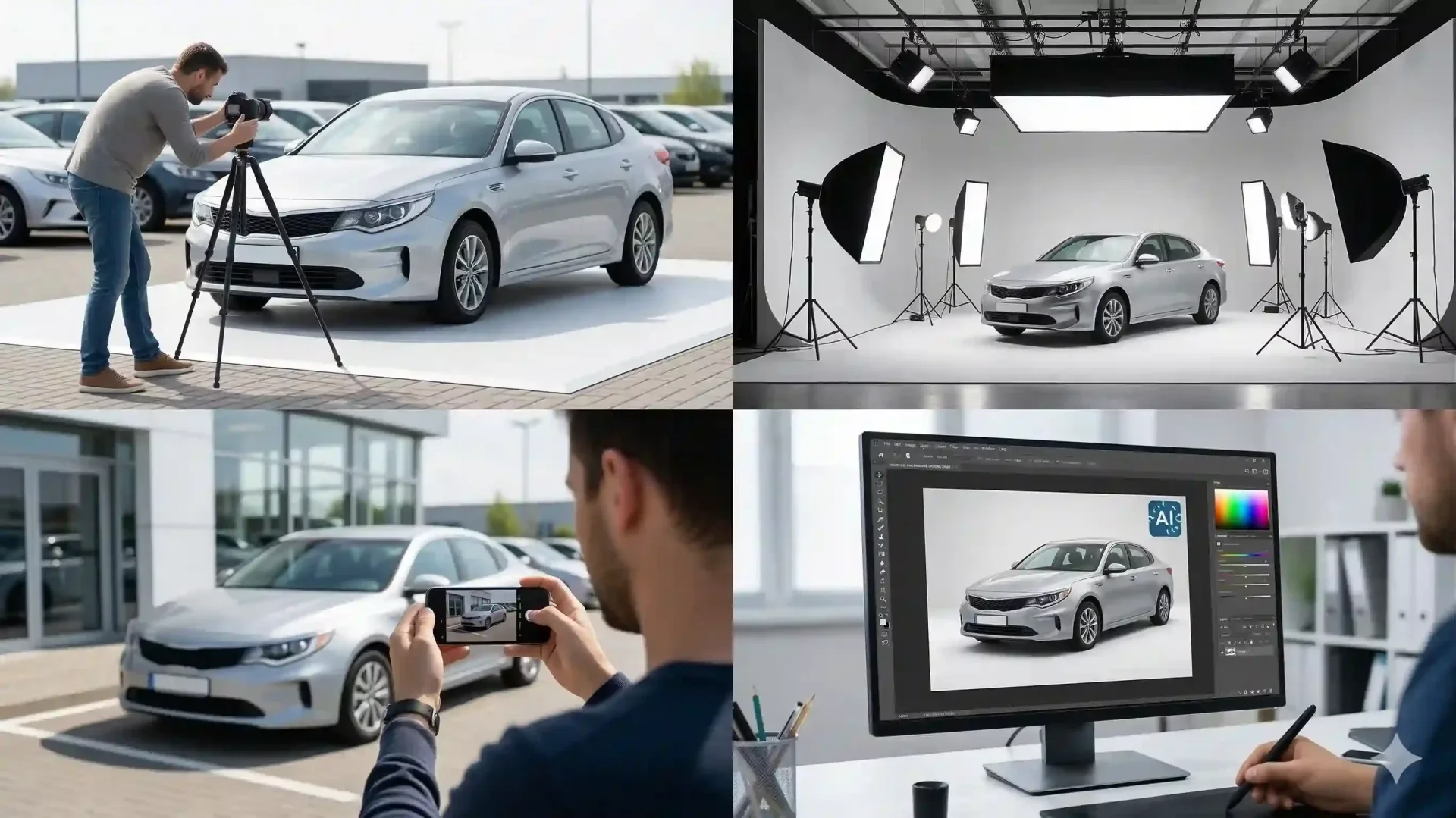
A car photoshoot can range from a 10-minute phone session on a dealer lot to a full-day production with lighting rigs, backdrops, and a professional photographer. The right approach depends on your budget, your volume, and where the images will be used. For most dealers, the goal is not a magazine cover shot. It is a consistent, professional set of images that gets each vehicle listed fast and builds buyer trust across every marketplace.
This guide covers the main types of automotive photoshoot, when each makes sense, and how to choose the right approach for your operation.
At a glance
- Lot shoot (phone or DSLR/mirrorless)
- Car photoshoot studio (rented)
- Dedicated photo bay on your lot
- Professional photographer
- Creative car photography for marketing
- AI-assisted lot shoot plus AI post-processing
Types of car photoshoot for dealer inventory
There is no single "right" way to shoot vehicle inventory. Each approach trades off cost, speed, quality, and consistency differently.
Photoshoot type | Cost per vehicle | Time per vehicle | Quality | Best for |
|---|---|---|---|---|
Lot shoot (phone) | $0 | 10-15 min | Variable | High-volume daily intake |
Lot shoot (DSLR/mirrorless) | $0 (equipment owned) | 15-20 min | Good | Dealers with trained staff |
Dedicated photo bay | $5K-15K setup | 10-15 min | Consistent | Mid-to-large dealers |
Car photoshoot studio (rented) | $200-500/session | 30-60 min | High | Hero shots, marketing campaigns |
Professional photographer | $30-100/vehicle | 20-40 min | High | Low-volume premium inventory |
AI-assisted (lot shoot + AI post) | Under $1/image | 10-15 min total | Consistent | Any volume, any budget |
The AI-assisted approach combines the speed and low cost of a phone lot shoot with the visual consistency of a studio result. You shoot raw photos on the lot and let AI handle background replacement, lighting correction, and color balancing in post-processing.
The lot shoot: car photoshoot ideas that work anywhere
Most dealer inventory photos start and end on the lot. This is the fastest and cheapest approach, but it requires discipline to produce consistent results.
The fundamentals are simple. Clean the vehicle thoroughly. Park it in a designated spot with the least cluttered background available. Shoot at the same time of day whenever possible, ideally early morning or late afternoon when light is soft and even. Follow the same angle sequence for every car: front three-quarter, rear three-quarter, driver side, passenger side, interior dashboard, rear seats, trunk, odometer.
Where lot shoots fail is consistency. Different staff, different days, different weather, different lot positions. The result is an inventory grid where no two cars look like they belong to the same dealership. This is where AI post-processing adds the most value. Shoot fast on the lot, then let the software standardize backgrounds, lighting, and color across every vehicle.
The car photoshoot studio option
A dedicated car photoshoot studio offers controlled lighting, clean backgrounds, and repeatable conditions. For high-value inventory or marketing campaigns, studio quality is worth the investment. For daily inventory at volume, it is usually not practical.
Renting a car photography studio typically costs $200-500 per session, with each vehicle taking 30-60 minutes to position, light, and shoot. That time and cost multiplied across 50 vehicles a month makes studio shooting prohibitive for most dealerships.
A middle ground is a dedicated photo bay on your lot: a section with a clean wall or portable backdrop, basic lighting, and a marked parking position. This costs $5K-15K to set up once and gives you semi-studio conditions without leaving the dealership. It does not match a professional studio, but it dramatically improves consistency over random lot shooting.
Automotive photoshoot with a professional photographer
Hiring a professional photographer for your inventory makes sense in specific situations:
- Low-volume premium inventory where each vehicle warrants individual attention
- Marketing campaigns requiring lifestyle or editorial-quality images
- Grand opening and special event photography
Professional automotive photoshoot rates range from $30-100 per vehicle depending on the number of shots and turnaround time. The per-vehicle cost often includes post-processing, but turnaround times of 2-5 days can delay your listings significantly.
For ongoing inventory photography, outsourcing every car to a photographer becomes expensive and slow. Most dealerships find a hybrid model works better: professional shoots for hero shots and campaigns, phone-plus-AI for daily inventory.
Creative car photography ideas for marketing
Beyond standard inventory shots, creative car photography ideas can elevate your marketing presence and social media engagement. These concepts work for occasional campaigns, not everyday listings.
Golden hour shoots use the warm, soft light of early morning or late afternoon to create dramatic, aspirational images. Position the car with the light source behind and slightly to the side for the best effect. These photos work exceptionally well on Instagram and Facebook where visual impact drives engagement.
Location-based shoots place the vehicle in a context that matches the buyer persona. A truck in front of a mountain trail. An SUV at a campsite. A luxury sedan outside a downtown restaurant. The background tells a story that standard inventory photos cannot.
Detail-focused creative car photography highlights specific features: a close-up of the headlight design, the stitching on a leather seat, the badge on the grille. These work as supporting images in listings and as standalone social content that shows attention to quality.
All of these creative approaches produce strong individual images, but they are not scalable for everyday inventory. Use them strategically for marketing content while your standard AI-assisted workflow handles daily listing photos.
Planning your car photoshoot schedule
Timing matters more than most dealers realize. The light at 9 AM looks completely different from the light at 1 PM, and mixing photos shot at different times creates the same inconsistency that backgrounding is meant to solve.
Block a consistent daily window for your automotive photoshoot work. Early morning (7-10 AM) or late afternoon (3-6 PM) gives you soft, even light that minimizes harsh shadows. If you must shoot at midday, park vehicles in open shade rather than direct sun.
For volume operations, batch your shoots. Process all new arrivals from the day in one session rather than shooting each car individually throughout the day. Batching keeps your lighting conditions consistent across the full set and makes AI post-processing more efficient since you upload everything at once.
How to choose the right car photoshoot approach for your dealership
The decision framework is straightforward. Answer three questions.
First, how many vehicles do you list per month? At 20+ vehicles, studio shooting and professional photographers become cost-prohibitive for routine inventory. Phone-plus-AI is the practical choice for volume.
Second, where do your listings appear? If you sell primarily on Cars.com and CarGurus, consistent backgrounds matter more than artistic flair. If Instagram and social media drive your leads, mixing in creative shots alongside standard inventory adds value.
Third, how fast do you need to list? If time-to-listing is a competitive advantage (and it almost always is), any approach that adds days to the process is working against you. An automotive photoshoot that produces great images in five days is less valuable than a good-enough lot shoot published the same afternoon.
Final thoughts
The best car photoshoot is the one that matches your volume, budget, and listing speed requirements. For most dealers, that means phone shooting on the lot combined with AI post-processing for backgrounds, lighting, and color consistency. Reserve studio sessions and professional photographers for hero shots and marketing campaigns where the per-image investment pays off. Try Car Background AI free on your next lot shoot batch to see how AI-assisted post-processing compares to your current workflow.
Frequently asked questions
How much does a car photoshoot cost for dealer inventory?
Costs vary widely by approach. Phone lot shoots cost nothing beyond staff time. Professional photographers charge $30-100 per vehicle. Renting a studio runs $200-500 per session. AI-assisted workflows (lot shoot plus automated post-processing) typically cost under $1 per image, making them the most cost-effective option for high-volume dealers.
What equipment do I need for an automotive photoshoot on the lot?
A modern smartphone with 12MP or higher resolution is sufficient for marketplace-quality inventory photos. Optional upgrades include a $20 polarizing filter clip-on to reduce glare, a small portable tripod for consistency, and a cleaning kit for the vehicle. Professional cameras are beneficial but not required for standard dealer listings.
How many photos should each car photoshoot produce?
Aim for 11-15 images per vehicle: front three-quarter, rear three-quarter, both side profiles, front and rear straight-on, dashboard, rear seats, trunk, odometer, and VIN plate. More angles give buyers a complete picture and reduce follow-up requests for additional photos. Some marketplaces accept up to 40 images per listing.
What are the best car photoshoot ideas for social media?
Golden hour shoots with warm directional lighting, location-based scenes matching the buyer persona (trucks at trailheads, luxury cars downtown), and detail close-ups of distinctive features all perform well on Instagram and Facebook. These creative approaches are best reserved for marketing content while standard inventory uses a consistent, repeatable process.
Can a car photoshoot studio be set up at the dealership?
Yes. A dedicated photo bay with a clean wall or portable backdrop, basic lighting, and a marked floor position costs $5K-15K to set up and gives you semi-studio conditions without leaving the lot. This is a practical middle ground between random lot shooting and renting an external car photoshoot studio for every vehicle.
How does AI post-processing compare to a professional automotive photoshoot?
AI post-processing produces consistent, marketplace-ready results from raw lot photos in seconds per image. Professional photography produces higher artistic quality but at significantly more time and cost per vehicle. For standard inventory listings, the visual difference is minimal when AI handles backgrounds, lighting, and color. Professional shoots remain valuable for marketing campaigns and hero images.

Tamas Magda
Co-founder, Growth and Partnerships at Car Background AI
Tamas Magda is co-founder of Car Background AI (carbackground.ai, CarBG), an AI car photo editor that replaces backgrounds on dealership inventory photos. He leads partnerships, growth, and business architecture, working with the development team on the product roadmap and with dealers on what their online listings actually need. He brings a background in venture building across APAC and MENA, and writes about vehicle merchandising, dealer photo workflows, and using AI on listing images without altering the car itself.
Tamas is a co-founder of Car Background AI and has a financial interest in the company. Articles that mention Car Background AI reflect that relationship.