Centralized vs Distributed Photo Processing: Which Model Fits Your Dealer Group
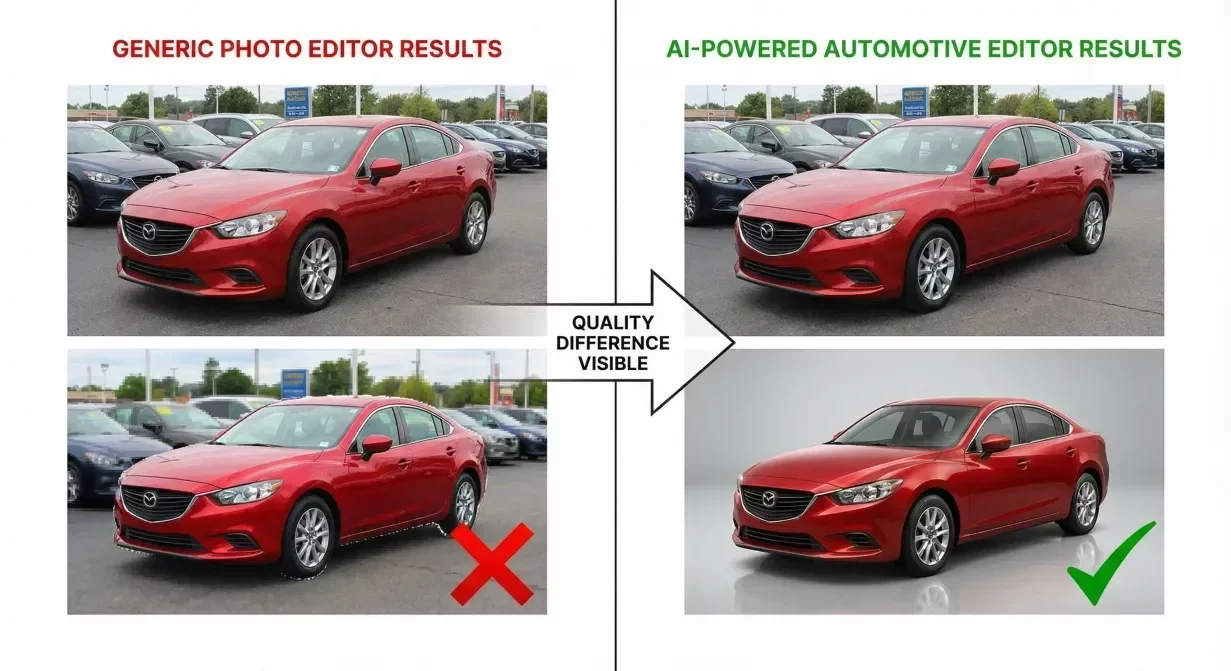
Dealer groups face a fundamental decision about photo processing: should each location handle its own photos, or should processing be centralized at one facility or team? Both models have advocates, and both can work. Car background quality plays a critical role in this process. The right choice depends on your specific operational context.
This comparison examines centralized and distributed processing models to help dealer groups make informed infrastructure decisions.
Understanding the two models
Distributed processing
In distributed processing, each dealership location captures and processes its own vehicle background photos. Processing happens where capture happens. Each location has the tools, training, and staff to complete the full workflow independently.
Centralized processing
In centralized processing, locations capture photos but send them to a central team or facility for processing. Capture is distributed; processing is consolidated. One team handles all processing for the entire group.
Speed and turnaround comparison
Distributed advantage: faster turnaround
When processing happens at the capture location, turnaround is typically faster. No file transfer delays between locations. No queue behind other locations' work. No communication overhead coordinating with a remote team.
For dealers where time-to-listing directly affects competitive position, distributed processing eliminates bottlenecks that centralized models can create.
Centralized consideration: transfer time adds delay
Centralized processing requires file transfer from each location to the central team, then return of processed files. Even with fast networks, this adds time. Queue position behind other locations' work adds more.
However, a well-staffed central team with optimized workflows can sometimes process faster than under-resourced local teams. The comparison is not automatic.
Consistency and quality comparison
Centralized advantage: easier consistency
When one team processes all photos, consistency is easier to achieve. Same people, same tools, same environment. No variation from different staff interpretations across locations. Quality standards apply uniformly because the same team applies them.
Training is simpler with a centralized team. Updates reach everyone immediately. Quality issues trace to identifiable team members rather than dispersed locations.
Distributed challenge: requires strong governance
Distributed processing can achieve consistency, but it requires stronger governance systems. Documentation must be more detailed. Training must reach more people. Auditing must verify compliance across multiple locations.
Without active governance, distributed processing drifts toward inconsistency as locations adapt processes locally.
Scalability comparison
Distributed advantage: natural scaling
Distributed processing scales naturally with location count. Each new location brings its own processing capacity. No single point becomes a bottleneck as the group grows. Volume spikes at one location do not affect others.
Centralized challenge: capacity limits
Centralized teams have capacity limits. As group volume grows, the central team must grow proportionally. Adding locations requires expanding central capacity. Volume spikes require either capacity buffer or delayed processing.
However, centralized teams can achieve economies of scale that distributed teams cannot. Specialized equipment or expertise justified by group-wide volume may not be justified at individual locations.
Cost comparison
Distributed costs
Each location needs processing tools and trained staff. Redundancy across locations means multiple subscriptions, multiple training investments, multiple management attention requirements. Total cost scales with location count.
Centralized costs
One processing setup serves all locations. Tool costs concentrate rather than distribute. Staff costs may be lower due to specialization efficiency. However, facilities and management costs for the central team must be considered.
Total cost comparison depends heavily on location count, volume per location, and tool pricing structures. Neither model is universally cheaper.
Risk and resilience comparison
Distributed advantage: no single point of failure
If one location's processing capability fails, other locations continue unaffected. Staff illness at one location does not create group-wide backlog. Technology problems at one site are localized.
Centralized risk: concentrated dependency
Central team problems affect all locations. Staff shortages, technology failures, or capacity limits create group-wide impact. Resilience requires deliberate redundancy that adds cost.
Management and control comparison
Centralized advantage: direct control
Central teams are directly managed by group leadership. Changes implement immediately. Quality issues address directly. Standards enforcement requires no cross-location coordination.
Distributed challenge: remote oversight
Distributed processing requires managing through influence rather than direct control. Location managers have competing priorities. Compliance depends on buy-in and accountability systems rather than direct supervision.
Hybrid approaches
Many dealer groups implement hybrid models that capture benefits of both approaches.
- Distributed capture, centralized finishing: Locations capture and perform initial processing; central team handles final quality verification and platform distribution.
- Centralized standards, distributed execution: Central team defines standards and templates; locations execute processing within those parameters.
- Tiered processing: Standard inventory processed locally; premium or complex vehicles routed to central specialists.
Decision framework
- Choose distributed when: Fast turnaround is critical, location count is high, volume per location justifies local investment, locations have capable staff, and strong governance systems exist.
- Choose centralized when: Consistency is paramount, central team can be adequately staffed, turnaround time is less critical, governance resources are limited, and specialized expertise justifies concentration.
How Car Background AI supports both models
Car Background AI's template-based processing supports both centralized and distributed models. Templates configured once apply consistently whether used by one central team or multiple location teams.
For distributed processing, Car Background AI's ease of use enables non-specialist staff at each location to produce consistent results. For centralized processing, batch capabilities handle volume from multiple locations efficiently.
Final thoughts
Neither centralized nor distributed photo processing is universally superior. The right choice depends on your priorities: speed favors distributed, consistency ease favors centralized. Many successful dealer groups implement hybrid models capturing benefits of both. Contact Car Background AI to discuss which processing model fits your dealer group's operational context. Try Car Background AI to streamline your car background workflow.
Frequently asked questions
Which model is more common among dealer groups?
Distributed processing with strong governance is most common. It provides speed advantages while scalable governance systems maintain consistency. Pure centralization is less common except in smaller groups.
Can I switch models after starting with one approach?
Yes, though switching has transition costs. Moving from distributed to centralized requires building central capacity. Moving from centralized to distributed requires training and equipping locations. Plan transitions carefully.
How do I maintain consistency with distributed processing?
Document standards thoroughly, standardize tools and templates across locations, train all staff consistently, audit regularly, and hold locations accountable for compliance.
What staff level does centralized processing require?
Depends on group volume. As a rough guide, one processor can handle 80-120 vehicle sets daily with appropriate tools. Size the central team to handle peak volume with some buffer.
How do I handle location-specific branding with centralized processing?
Configure location-specific templates within the centralized system. Tag incoming files by location and apply appropriate templates automatically or through simple selection.

Tamas Magda
Co-founder, Growth and Partnerships at Car Background AI
Tamas Magda is co-founder of Car Background AI (carbackground.ai, CarBG), an AI car photo editor that replaces backgrounds on dealership inventory photos. He leads partnerships, growth, and business architecture, working with the development team on the product roadmap and with dealers on what their online listings actually need. He brings a background in venture building across APAC and MENA, and writes about vehicle merchandising, dealer photo workflows, and using AI on listing images without altering the car itself.
Tamas is a co-founder of Car Background AI and has a financial interest in the company. Articles that mention Car Background AI reflect that relationship.