Dealer Group Photo Standards Template: The Complete Governance Document
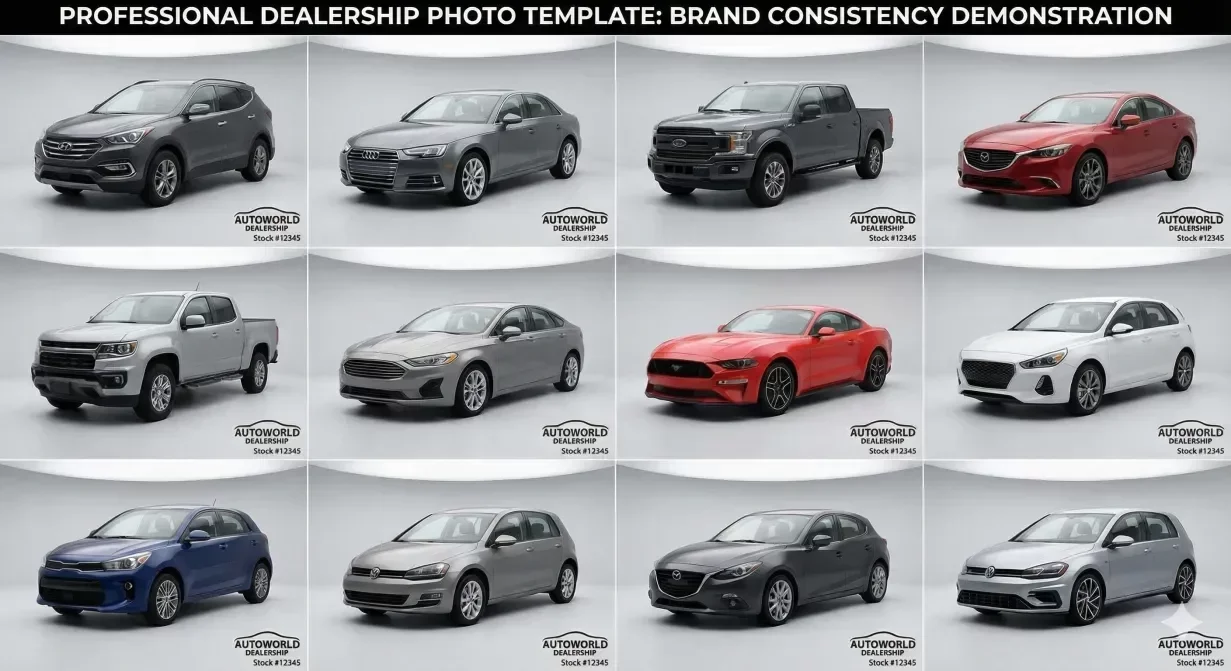
This dealer group photo standards template provides the governance framework multi-location operations need to maintain visual consistency. Customize each section for your specific requirements, distribute to all locations, and use as the authoritative reference for Car background quality expectations.
At a glance
- Purpose and scope
- Capture standards
- Processing standards
- Quality standards
- Export and platform requirements
- Roles and responsibilities
- Compliance and enforcement
Photo standards document template
Section 1: Purpose and scope
- Purpose: This document establishes visual standards for vehicle photography across all [DEALER GROUP NAME] locations. Compliance with these standards is mandatory for all staff involved in vehicle photography and image processing.
- Scope: These standards apply to all inventory photography for online listings, all marketplace and website photo uploads, all locations within the dealer group, and all staff who capture, process, or approve vehicle photos.
- Effective Date: [DATE]
- Document Owner: [NAME/TITLE]
- Review Schedule: This document will be reviewed and updated [QUARTERLY/ANNUALLY] or when significant process changes occur.
Section 2: Capture standards
- 2.1 Required Shot Sequence: Every vehicle must include hero three-quarter front, front direct, driver side profile, rear three-quarter, rear direct, passenger side profile, interior dashboard view, front seats, rear seats, center console/infotainment, gauge cluster with odometer visible, and trunk/cargo area.
- 2.2 Vehicle Preparation Requirements: Before photography, every vehicle must be exterior washed and dried, interior vacuumed and wiped down, windows cleaned inside and out, personal items removed, floor mats properly positioned, and dealer plates attached correctly.
- 2.3 Technical Capture Requirements: Minimum resolution [2000] pixels on longest edge, sharp focus on vehicle body, exposure locked on vehicle, vehicle centered with buffer space, and landscape orientation for all exterior shots.
Section 3: Processing standards
- 3.1 Approved Templates: Only approved background templates may be used. Document template names, descriptions, and use cases in a table format.
- 3.2 Processing Settings: Standard enhancement settings for lighting optimization, color enhancement, and shadow intensity must be applied identically across all locations.
- 3.3 Processing Platform: All photo processing must use [PLATFORM NAME]. Alternative tools are not permitted without written approval.
- 3.4 Prohibited Edits: Removing or concealing vehicle damage, altering vehicle color beyond standardization, adding elements not present, cropping that removes required areas, and using non-approved backgrounds are prohibited.
Section 4: Quality standards
- 4.1 Edge Quality Criteria: No visible halos or fringing, mirrors and antennas intact, wheel areas clean, smooth transitions.
- 4.2 Shadow Criteria: Shadows present beneath all vehicles, positioned consistently, intensity appropriate, visible under wheel wells.
- 4.3 Consistency Criteria: All photos in each set use identical background template, enhancement levels consistent across all angles, no visible variation in color treatment.
Section 5: Export and platform requirements
Document export specifications by platform including dimensions, format, and max file size for dealer website, Cars.com, AutoTrader, CarGurus, and Facebook Marketplace.
- File Naming Convention: [STOCK#]_[ANGLE#]_[LOCATION CODE].jpg
Section 6: Roles and responsibilities
Define responsibilities for photographers, processors, location managers, and group management including capture requirements, template application, compliance monitoring, and standards maintenance.
Section 7: Compliance and enforcement
Establish quality audit schedule, non-compliance handling procedures, and standards change request process.
How Car Background AI supports standards implementation
Car Background AI provides the template-based processing that makes standards enforcement practical. Configure approved templates once; all locations apply them consistently.
The platform's consistent output quality ensures that standards documented here translate into actual visual consistency across your dealer group.
Final thoughts
A photo standards document transforms good intentions into enforceable practices. This template provides the structure; your specific requirements provide the content. Implement Car Background AI as the processing platform that makes your standards achievable at scale.
Frequently asked questions
How detailed should my standards document be?
Detailed enough that someone unfamiliar with your operation could follow it correctly. Include visual examples wherever possible. Ambiguity creates inconsistency.
How often should I update photo standards?
Review at least annually, and update whenever significant changes occur to tools, platforms, or business requirements.
Who should approve standards changes?
Group-level management should approve all standards changes to prevent local modifications that create inconsistency.
How do I get location buy-in on standards?
Involve location managers in standards development. Provide training that explains why, not just what. Share quality audit results transparently.
What if a location has legitimate reasons for different standards?
Evaluate requests carefully against brand consistency goals. If approved, document the exception and its scope clearly.

Tamas Magda
Co-founder, Growth and Partnerships at Car Background AI
Tamas Magda is co-founder of Car Background AI (carbackground.ai, CarBG), an AI car photo editor that replaces backgrounds on dealership inventory photos. He leads partnerships, growth, and business architecture, working with the development team on the product roadmap and with dealers on what their online listings actually need. He brings a background in venture building across APAC and MENA, and writes about vehicle merchandising, dealer photo workflows, and using AI on listing images without altering the car itself.
Tamas is a co-founder of Car Background AI and has a financial interest in the company. Articles that mention Car Background AI reflect that relationship.