The Hidden Cost of Bad Car Photos: How Quality Problems Kill Deals
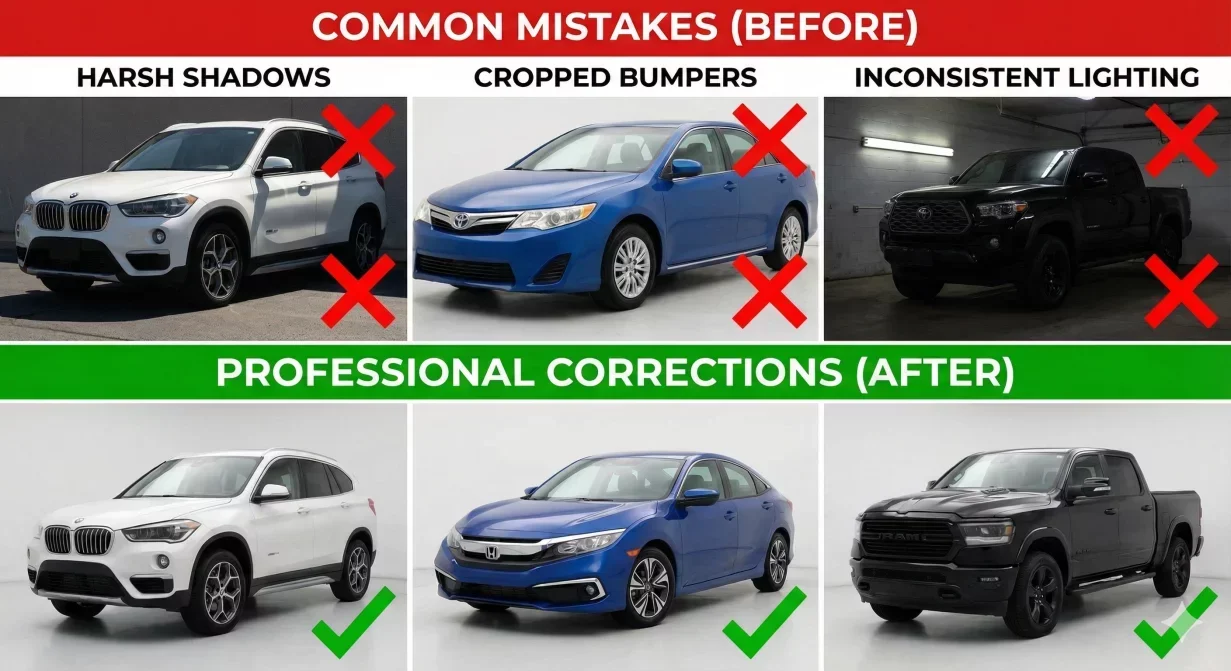
Bad Car background photos cost more than most dealers realize. The impact extends beyond missed clicks to affect lead quality, sales velocity, and even pricing power. Understanding these hidden costs helps justify appropriate investment in photo quality.
The Visibility Cost
Poor photos reduce the number of buyers who ever see your listings.
Lower Click-Through Rates
Marketplace search results display thumbnails. Buyers click on professional-looking listings and scroll past amateur ones. Poor photo quality means fewer eyeballs on your inventory, regardless of vehicle quality or pricing.
Even small CTR differences compound across inventory. If poor photos reduce clicks by 20%, you are losing one in five potential buyers before they ever see your listing details.
Algorithmic Penalties
Marketplace algorithms incorporate engagement signals. Listings with low click rates receive less visibility. Poor photos create a downward spiral: low engagement leads to reduced visibility leads to even lower engagement.
Competitors with better photos receive algorithmic preference, appearing higher in search results and capturing attention your listings never receive.
Reduced Time on Listing
Buyers who do click on poor-quality listings leave quickly. Short visit duration signals low relevance to algorithms, further reducing visibility.
The Lead Quality Cost
Poor photos attract the wrong buyers and repel the right ones.
Bargain Hunter Attraction
Amateur photos signal desperation or low dealer standards. This attracts buyers looking for deals on distressed inventory rather than buyers seeking quality vehicles at fair prices.
These leads require more negotiation, expect lower prices, and close at lower rates. The time spent on low-quality leads displaces attention from better opportunities.
Serious Buyer Repulsion
Quality-conscious buyers use photo quality as a proxy for dealer quality. If photos look careless, buyers assume the dealership operates carelessly. They move to competitors whose presentation matches their expectations.
The buyers you most want to attract are the ones most sensitive to quality signals. Poor photos filter out your best prospects.
Increased Buyer Skepticism
Poor photos raise questions about what you are hiding. Dark interiors suggest concealed damage. Cluttered backgrounds suggest disorganization. Inconsistent quality suggests unreliability.
This skepticism carries into negotiations. Buyers who distrust your presentation distrust your descriptions and pricing. Every conversation starts from a position of doubt rather than confidence.
The Sales Velocity Cost
Poor photos extend time-to-sale across your inventory.
Slower Initial Interest
Quality listings generate inquiries quickly. Poor listings sit while buyers evaluate other options. The first days after listing are most valuable for generating interest; poor photos waste this window.
Extended Negotiation
Buyers who engage despite poor photos enter negotiations with leverage. They expect concessions to compensate for the uncertainty your photos created. Deals take longer and close at lower margins.
Increased Days on Lot
Every additional day a vehicle sits costs money: floor plan interest, opportunity cost, depreciation. Poor photos extend average days on lot across your inventory, multiplying carrying costs.
The Pricing Power Cost
Poor photos undermine your ability to command fair prices.
Perceived Value Reduction
Professional photos communicate vehicle value effectively. Poor photos fail to convey condition, features, and appeal. Buyers cannot justify paying market price for vehicles they cannot properly evaluate.
The same vehicle photographed professionally versus poorly can command different prices simply because buyers perceive value differently based on presentation.
This is especially true for premium and bespoke vehicles. A fully restored Heritage Defender can represent hundreds of thousands in craftsmanship, but poor photos reduce it to just another used SUV in a buyer's eyes.
Competitive Disadvantage
When your listings appear beside competitors with better photos, buyers develop relative preferences. Similar vehicles with better presentation seem more appealing, more trustworthy, and worth more.
You compete not just on vehicle quality and price but on presentation quality. Losing the presentation competition means losing deals or accepting lower prices.
Negotiation Weakness
Poor photos give buyers ammunition. They can point to uncertainty, raise questions about condition, and justify lower offers. You defend against objections that professional photos would have prevented.
The Operational Cost
Poor photo processes create ongoing inefficiency.
Rework and Corrections
Inconsistent quality requires frequent correction. Manager review, rejection, recapture, and reprocessing consume time that could go to selling. The rework loop becomes a constant drag on operations.
Customer Service Burden
Poor photos generate questions that good photos answer automatically. Staff time spent explaining what photos should have shown is time not spent closing deals.
Returns and Complaints
When buyers feel misled by photos, they return vehicles or leave negative reviews. The cost of unwinding deals and managing reputation damage far exceeds the cost of quality photos.
Calculating Your Photo Quality Cost
Estimate your specific cost with these factors:
- CTR difference between your best and worst photo quality listings
- Average days on lot for quality photos versus poor photos
- Close rate difference by photo quality
- Average price achieved for similar vehicles with different photo quality
- Staff time spent on photo-related rework and customer questions
Even conservative estimates typically show that photo quality investment pays for itself multiple times over.
The Investment Perspective
Reframe photo quality as investment rather than expense.
Cost Per Vehicle Context
Professional photo processing might cost a few dollars per vehicle. Compare to the thousands in carrying costs, lost margin, and opportunity cost from extended time on lot or reduced pricing power.
ROI Calculation
If better photos reduce average days on lot by even 2-3 days, or increase average sale price by 1-2%, the return vastly exceeds the investment. Quality photos are among the highest-ROI investments a dealer can make.
How CarBG Addresses Photo Quality Costs
CarBG provides professional-quality processing at operational cost levels. Consistent quality across inventory eliminates the variability that creates hidden costs.
The platform is designed for dealer economics—investment that returns multiples through faster sales, better leads, and stronger pricing.
Final Thoughts
Bad car photos cost far more than the visible expense of fixing them. Hidden costs in visibility, lead quality, sales velocity, pricing power, and operations compound into significant business impact. Appropriate investment in photo quality is not expense but high-return investment in sales effectiveness. Contact CarBG to discuss how quality photos fit your dealership economics. Try CarBG to streamline your car background workflow.
The CarBG Angle (FAQ Bits)
How much do bad photos really cost?
Costs vary by dealer, but typical impacts include 15-30% lower CTR, 3-7 additional days on lot, and 1-3% lower average sale prices. Multiply across inventory volume for total impact.
Is photo quality really that important compared to pricing?
Photos determine whether buyers evaluate your pricing at all. The best price is invisible if poor photos prevent clicks. Quality photos and competitive pricing work together.
Can I measure the impact of improving photos?
Yes. Track CTR, days on lot, and close rates before and after photo quality improvements. Even short measurement periods reveal significant differences.
What photo quality investment makes sense?
Investment that costs less than the hidden costs it eliminates. For most dealers, professional processing at a few dollars per vehicle returns many times the cost.
Do online buyers really care about photo quality?
Online buyers cannot evaluate vehicles any other way. Photos are their primary—often only—basis for initial decisions. Quality matters enormously in digital-first discovery.
How quickly do photo improvements show results?
CTR improvements are visible within days. Lead quality and velocity improvements become clear over weeks. Full impact including pricing power emerges over months as quality reputation builds.

Tamas Magda
Co-founder, Growth and Partnerships at Car Background AI
Tamas Magda is co-founder of Car Background AI (carbackground.ai, CarBG), an AI car photo editor that replaces backgrounds on dealership inventory photos. He leads partnerships, growth, and business architecture, working with the development team on the product roadmap and with dealers on what their online listings actually need. He brings a background in venture building across APAC and MENA, and writes about vehicle merchandising, dealer photo workflows, and using AI on listing images without altering the car itself.
Tamas is a co-founder of Car Background AI and has a financial interest in the company. Articles that mention Car Background AI reflect that relationship.