How AI Car Photo Editors Improve Lead Quality on Used Car Marketplaces
You recognize the pattern within a week of listing vehicles online. Some inquiries arrive detailed and specific: "Is the service history complete? Can you confirm the tires have 6mm+ tread? I'd like to schedule a test drive Saturday at 2pm." These leads convert. They show up, they're prepared, they make decisions.
Other inquiries feel scattered and uncertain: "Is this car good? How much can you come down? Can you send more pics? What's wrong with it?" These leads consume hours of back-and-forth messaging, frequently cancel appointments, and rarely convert into sales.
The difference often starts with your photos.
Image quality doesn't just determine whether buyers notice your listings—it fundamentally shapes who contacts you and how serious they are. Clean, well-lit, professionally presented vehicle photos attract confident, informed shoppers. Poor photos draw hesitant, skeptical inquiries from people who can't tell what they're actually looking at.
AI car photo editors help you consistently deliver the image quality that generates better leads—the kind who arrive informed, ready to engage seriously, and far more likely to close.
The Psychology Behind Photo Quality and Buyer Behavior
Buyers make rapid, subconscious assessments when browsing vehicle listings. Within 2-3 seconds of seeing your photos, they've formed opinions about the vehicle's condition, your dealership's professionalism, and whether this listing deserves serious consideration.
Poor image quality triggers psychological red flags:
Uncertainty about condition: Dark photos with harsh shadows make buyers wonder what you're hiding. If they can't clearly see panel gaps, paint quality, interior wear, or mechanical details, they assume the worst. "Why wouldn't they show this clearly unless there's damage?"
Distrust of the seller: Cluttered backgrounds, inconsistent angles, and amateur photography signal lack of attention to detail. Buyers extrapolate: "If they can't be bothered to take decent photos, what else are they cutting corners on? Vehicle inspection? Reconditioning? Pricing transparency?"
Decision paralysis: When photos don't provide clear information, buyers can't confidently evaluate the vehicle. They reach out with basic, tentative questions because they're not sure what they're looking at. These low-confidence inquiries consume your time but rarely convert.
High-quality images create the opposite psychological effect:
Confidence in condition: Clear, well-lit photos from comprehensive angles let buyers thoroughly evaluate the vehicle remotely. They can see paint quality, interior condition, tire tread, and details that answer common questions before they even ask.
Trust in professionalism: Consistent, professional presentation signals operational excellence. Buyers assume—often correctly—that dealerships maintaining high visual standards also maintain high standards in vehicle selection, reconditioning, and customer service.
Informed decision-making: When buyers can clearly see what they're considering, they arrive at your dealership or contact you with specific, informed questions. They've already done their evaluation. They're reaching out because they're genuinely interested, not because they're confused.
Common Visual Problems Destroying Lead Quality
Walk through your current marketplace listings. You'll likely spot these recurring issues:
Obstructed views: The vehicle you're trying to showcase is partially blocked by other cars, cones, posts, or equipment. Buyers literally can't see the full vehicle, so they can't evaluate it properly.
Distracting backgrounds: Chain-link fences, cluttered service bays, busy streets, other vehicles, signage, utilities—the background competes with the car for attention. Buyers' eyes don't know where to focus, and the vehicle gets lost in visual noise.
Harsh or inadequate lighting: Midday sun creates harsh shadows that hide details. Overcast conditions flatten everything into dull gray. Indoor shots with poor lighting make interiors look dingy regardless of actual condition. Buyers can't see clearly, so they hesitate.
Inconsistent shooting styles: Different staff members photograph vehicles differently—varying angles, distances, compositions. One listing has 15 photos, another has 8. One shows the engine bay, another doesn't. This inconsistency makes your inventory feel disorganized and your operation feel unprofessional.
Low resolution or poor focus: Blurry images, overly compressed files, or photos taken from too far away don't provide the detail buyers need to evaluate condition. When they can't see clearly, they either skip your listing or contact you with basic questions that photos should have answered.
Each of these problems lowers lead quality. Serious buyers with money ready to spend don't waste time on listings where they can't clearly see what they're buying. They move on to better-presented inventory—likely from your competitors.
Who does contact you? Bargain hunters assuming poor presentation means desperate seller. Uncertain shoppers who need extensive hand-holding. Time-wasters who aren't serious but figure they'll ask some questions. Your inquiry volume might stay steady, but conversion rates suffer.
How AI Photo Editors Transform Lead Quality
AI car photo editors systematically eliminate the visual problems that attract low-quality leads while creating the professional presentation that draws serious buyers.
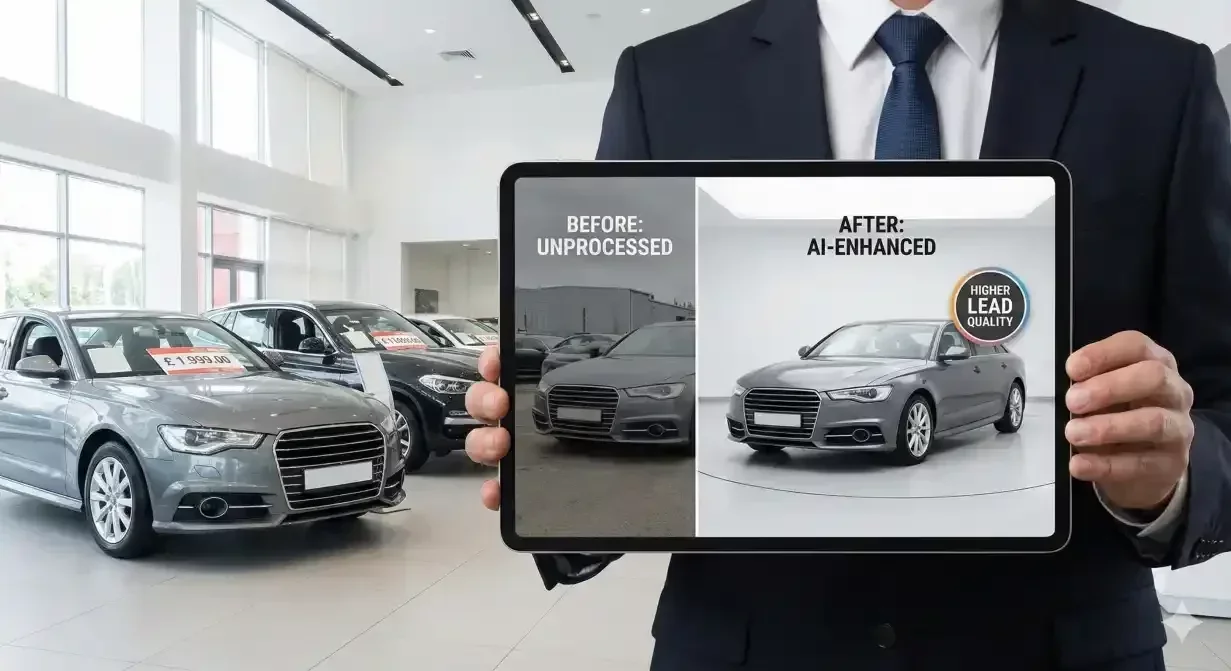
Background removal and replacement: AI precisely isolates the vehicle and removes all distracting elements—other cars, fences, clutter, equipment, everything. The vehicle then appears on a clean, neutral background that puts 100% of visual focus on what matters. Buyers can actually see and evaluate the car without environmental distractions. With the help of an AI software consultancy, businesses can also tailor these image-processing workflows to their specific requirements and automate them at scale.
Lighting correction and enhancement: AI analyzes each image and automatically adjusts exposure, contrast, and color balance to reveal details that poor lighting obscures. Harsh shadows get softened. Underexposed areas get brightened. The vehicle's true color and condition become clearly visible.
Consistent professional presentation: Regardless of who took the photos, where the vehicle was parked, or what time of day it was shot, AI processing delivers consistent output quality. Every listing maintains the same professional standard, creating brand coherence that builds buyer confidence.
Shadow and lighting rendering: Advanced AI doesn't just remove backgrounds—it renders natural shadows and lighting that make vehicles look properly grounded in their new environment. This subtle realism prevents the "cut-and-paste" appearance that undermines credibility.
The cumulative effect on leads:
Buyers scrolling through marketplace results encounter your listings and immediately notice the difference. Clean presentation. Clear details. Professional consistency. They can actually see what they're considering.
This visual clarity enables self-qualification. Serious buyers gather the information they need from photos and arrive with informed, specific questions. They've already decided they're interested—they're reaching out to confirm details and schedule appointments.
Meanwhile, the uncertain, low-intent shoppers who would normally contact you with vague questions can answer those questions themselves by looking at your comprehensive, clear photos. They either self-qualify in (becoming better leads) or self-qualify out (saving you time), but they're less likely to waste your team's time with low-commitment inquiries.
The Lead Quality Metrics That Improve
When you upgrade to AI-enhanced photography, specific lead quality indicators shift measurably:
Inquiry specificity increases: Instead of "Is this car good?" you receive "Can you confirm the maintenance history is complete and whether the timing belt has been replaced?" Specific questions indicate serious interest and informed buyers.
Appointment show rates improve: Buyers who schedule test drives based on clear, comprehensive photos show up more reliably because they've already confirmed the vehicle meets their requirements. They're not showing up to discover deal-breaking issues your photos should have revealed.
Time-to-conversion shortens: Informed buyers make faster decisions. They've done their evaluation online through your high-quality photos. The in-person visit confirms what they already know rather than introducing new information that requires additional consideration time.
Negotiation friction decreases: When photos accurately represent condition, buyers arrive with realistic expectations. There's no "Well, the photos didn't show this wear" or "This looks worse in person than online" ammunition for aggressive negotiation. Your asking price feels justified because presentation matched reality.
Deposit willingness increases: Confident buyers who trust what they've seen in photos are more willing to place deposits to hold vehicles, especially for desirable inventory. Professional presentation builds the trust required for remote commitments.
Question volume per lead decreases: Each inquiry still represents a potential sale, but serious buyers need fewer clarifying questions because your photos already provided comprehensive information. Your team spends less time answering basics and more time closing deals.
The Competitive Filtering Effect
Here's what many dealers miss: improving photo quality doesn't just make your listings more attractive—it actively filters the buyer pool in your favor.
When your photos are demonstrably better than competitors', you attract a disproportionate share of the most desirable buyers: those who are informed, ready to purchase, and willing to pay fair prices for quality vehicles presented professionally.
These buyers actively seek out listings with comprehensive, clear photography because it makes their decision process more efficient. They don't want to waste time on poor listings any more than you want to waste time on poor leads.
Meanwhile, your competitors with inferior photography get stuck with:
- Price-obsessed shoppers who assume poor presentation means desperate seller
- Uncertain buyers who need extensive hand-holding through basic evaluation
- High no-show rates from people who aren't actually serious
- Endless questions that professional photos would have answered
You're not just competing for attention—you're competing for the quality of attention. AI-enhanced photography helps you win that competition.
Practical Application: The Complete Picture
Lead quality improvement requires comprehensive visual coverage, not just better individual photos.
Standard angle set: Establish a consistent list of required angles for every vehicle—front 3/4, rear 3/4, both sides, front straight, rear straight, interior dash, front seats, rear seats, cargo area, engine bay, odometer, any damage or wear areas. Completeness builds buyer confidence.
Detail shots that answer questions: Include close-ups of elements buyers care about—tire tread depth, wheel condition, infotainment screen, seat wear, shifter, pedals. These details preemptively answer questions and demonstrate transparency.
Consistent processing across all images: Apply the same AI enhancement and background treatment to every photo in each listing. Visual consistency within a listing reinforces professionalism and makes evaluation easier for buyers.
Accurate representation: AI should enhance presentation, not deceive. Use lighting correction and background removal to show the vehicle clearly, but never hide damage, alter colors, or misrepresent condition. Accuracy builds trust; deception destroys it and generates nightmare leads who feel misled.
How CarBG Supports Better Lead Generation
CarBG was designed to help dealerships systematically improve the visual quality that drives lead quality.
The platform handles:
Automated background cleanup: Remove distracting elements and replace with professional environments in batch operations—process entire vehicle photo sets at once rather than editing individual images.
Intelligent lighting enhancement: Automatic exposure, contrast, and color correction that reveals vehicle details clearly without creating artificial, oversaturated appearances that damage credibility.
Consistent output quality: Regardless of input quality variations, CarBG delivers professional results that maintain your brand standard across all inventory.
Scalable workflow: Process high volumes without quality degradation—whether you're handling 10 vehicles monthly or 200, every listing receives the same enhancement level.
The goal isn't perfection for perfection's sake—it's creating the visual clarity and professionalism that attracts informed, serious buyers instead of uncertain, low-commitment inquiries.
Measuring the Shift
Once you implement AI-enhanced photography, track these indicators to quantify lead quality improvement:
Conversion rate by inquiry source: What percentage of marketplace inquiries result in appointments? In sales? Compare pre and post-implementation to measure improvement.
Average questions per lead: Count how many clarifying questions each inquiry requires before appointment scheduling. Fewer questions indicates better-informed leads.
Show rate for scheduled appointments: What percentage of scheduled test drives actually happen? Higher show rates indicate more serious, committed buyers.
Time from inquiry to sale: How long does the average lead take to convert? Shorter cycles indicate more decisive, informed buyers.
Gross profit per sale: Are you maintaining stronger margins because buyers arrive with realistic expectations rather than ammunition for aggressive negotiation?
Most dealerships implementing professional AI-enhanced photography see measurable improvements across these metrics within 30-60 days—evidence that lead quality, not just lead volume, has genuinely improved.
The Long-Term Compounding Effect
Better lead quality creates advantages that compound over time:
Staff morale improves: Your team spends more time with serious buyers and less time fielding low-intent questions or dealing with no-shows. This makes the work more satisfying and productive.
Reputation strengthens: Serious buyers who have positive experiences become referral sources. They tell friends "This dealership has their act together—professional presentation, accurate descriptions, smooth process."
Review quality improves: Informed buyers whose expectations were accurately set by comprehensive photos leave better reviews. There's no "photos were misleading" or "condition was worse than shown" complaints undermining your online reputation.
Inventory turns faster: Better leads convert more quickly, reducing days-to-sale and improving cash flow. Professional presentation helps vehicles move at asking price rather than requiring aggressive discounting.
Marketing efficiency increases: When your conversion rates improve, your cost-per-sale decreases even if marketing spend stays constant. You're getting better returns from the same traffic.
The Bottom Line on Lead Quality
Not all inquiries are created equal. Volume means nothing if those leads don't convert. The quality of your vehicle photography directly determines the quality of buyers who contact you. Poor photos attract uncertain, price-focused, high-maintenance leads. Professional photos attract informed, serious, ready-to-buy customers.
AI car photo editors make professional presentation achievable at scale—not just for premium inventory, but for every single vehicle you list. This consistent quality standard filters your lead pool toward the buyers you actually want: informed, decisive, and ready to transact.
Your competitors are still dealing with the lead quality that poor photography generates—endless questions, frequent no-shows, aggressive negotiation, slow decision cycles. You can leave them to it.
With AI-enhanced photography, you attract the leads who make your job easier and your business more profitable. That's not a luxury—it's a fundamental competitive advantage in a market where buyer behavior starts online and first impressions are formed in seconds.
The question isn't whether photo quality affects lead quality—it demonstrably does. The question is whether you'll leverage that connection or continue leaving it to chance.
Frequently asked questions
How do better photos improve lead quality?
Clear, consistent photos let buyers assess a vehicle before they reach out, so the inquiries that follow tend to be more specific and better prepared. Cluttered or unclear images can attract vague questions or window shoppers. Presentation acts as a filter that shapes who contacts you.
Can editing photos hide a vehicle's real condition?
Editing to remove distractions and improve clarity is different from hiding damage or misrepresenting a car. The aim is to present the vehicle accurately so buyers know what they are inquiring about. CarBG focuses on clean presentation rather than disguising condition.
What lead metrics tend to improve with better photos?
This article points to indicators like more detailed inquiries and buyers who are further along in their decision. Better presentation can also reduce back-and-forth on basic questions the photos already answer. The exact effect varies by dealership and marketplace.

Tamas Magda
Co-founder, Growth and Partnerships at Car Background AI
Tamas Magda is co-founder of Car Background AI (carbackground.ai, CarBG), an AI car photo editor that replaces backgrounds on dealership inventory photos. He leads partnerships, growth, and business architecture, working with the development team on the product roadmap and with dealers on what their online listings actually need. He brings a background in venture building across APAC and MENA, and writes about vehicle merchandising, dealer photo workflows, and using AI on listing images without altering the car itself.
Tamas is a co-founder of Car Background AI and has a financial interest in the company. Articles that mention Car Background AI reflect that relationship.