Vehicle Photography In-House vs Outsourced: Comparing Quality, Speed, and Control
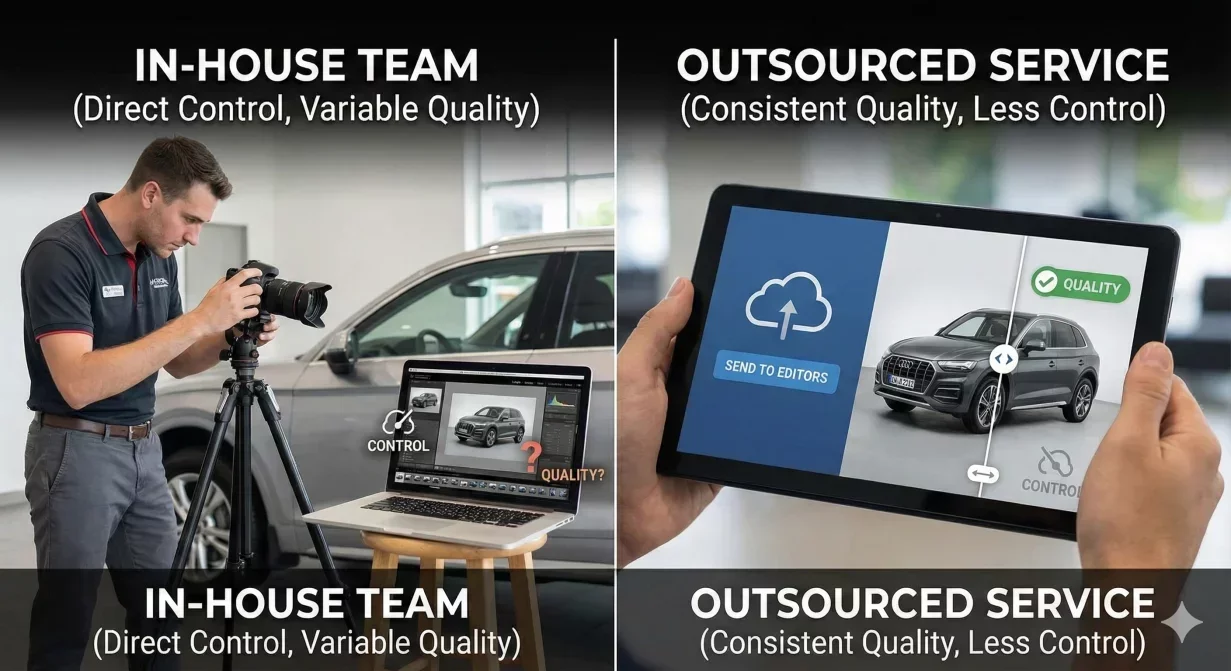
Vehicle photography done in-house versus outsourced represents a fundamental operational choice. Car background quality plays a critical role in this process. Each approach offers distinct advantages in quality control, turnaround time, cost structure, and scalability. This comparison helps dealers evaluate which model fits their specific volume, resources, and operational priorities.
Understanding the In-House Model
In-House Advantages
Control and responsiveness: When photography is in-house, you control priorities, timing, and quality standards directly. Rush requirements and immediate corrections happen without external coordination.
Speed to listing: Internal workflows eliminate handoffs and vendor scheduling. Same-day capture-to-publish becomes achievable.
Cost predictability: Per-vehicle costs tend to decrease as volume increases.
In-House Challenges
Skill development: Quality photography requires learned skills. Training staff takes time.
Capacity constraints: In-house capacity is limited by staff availability. Volume spikes may exceed what internal resources can handle.
Understanding the Outsourced Model
Outsourced Advantages
Professional expertise: Photography vendors bring refined skills and experience across many clients.
Scalability: External providers can scale capacity up or down with your needs.
No internal training: You purchase capability rather than developing it.
Outsourced Challenges
Turnaround time: External providers introduce delays. One to three days typical between vehicle arrival and photo availability.
Control limitations: Rush requests may be difficult or expensive.
Cost at volume: Per-vehicle pricing becomes significant at high volume.
Hybrid Approaches
In-House Capture, Outsourced Processing
Your staff photographs vehicles on lot, then external services process the photos. This captures speed advantages from internal capture while gaining professional processing quality.
In-House with Software Automation
Internal capture combined with automated processing software provides in-house control and speed while achieving professional results without extensive processing expertise.
Decision Framework
Consider In-House When:
- Volume exceeds 30-40 vehicles monthly
- Speed to listing is a competitive priority
- You want complete control over quality and timing
- Appropriate processing tools make in-house quality achievable
Consider Outsourced When:
- Volume is under 20 vehicles monthly
- Staff resources are stretched with existing duties
- Turnaround time of one to three days is acceptable
How CarBG Enables the In-House Model
CarBG makes in-house vehicle photography practical by eliminating the processing expertise barrier. Template-based automated processing produces professional results without specialized editing skills.
Dealers can capture on lot with confidence that CarBG processing will deliver consistent, marketplace-ready output.
Final Thoughts
Vehicle photography in-house versus outsourced involves trade-offs evaluated against your specific operational context. In-house offers speed and control; outsourced offers reliability and simplicity. Many dealers find in-house capture with automated processing provides optimal balance. Try CarBG to see how in-house photography becomes practical with the right processing tools.
The CarBG Angle (FAQ Bits)
At what volume does in-house photography make sense?
Generally above 30-40 vehicles monthly, in-house becomes cost-effective. Below 20, outsourcing often costs less.
How much faster is in-house versus outsourced?
In-house can achieve same-day capture-to-publish. Outsourced typically requires one to three days.
Can I achieve professional quality in-house?
Yes, with appropriate tools and basic training. Modern processing tools like CarBG produce professional results without traditional photo editing expertise.
What are the hidden costs of outsourcing?
Lost marketplace visibility from delayed listing, communication overhead for special requests, and limited flexibility for rush situations.
What if my volume varies seasonally?
Hybrid approaches work well. Maintain baseline in-house capability for normal periods; use outsourced overflow capacity for peaks.
How do I transition from outsourced to in-house?
Select tools first, train staff second, run parallel operations third, transition gradually fourth.

Tamas Magda
Co-founder, Growth and Partnerships at Car Background AI
Tamas Magda is co-founder of Car Background AI (carbackground.ai, CarBG), an AI car photo editor that replaces backgrounds on dealership inventory photos. He leads partnerships, growth, and business architecture, working with the development team on the product roadmap and with dealers on what their online listings actually need. He brings a background in venture building across APAC and MENA, and writes about vehicle merchandising, dealer photo workflows, and using AI on listing images without altering the car itself.
Tamas is a co-founder of Car Background AI and has a financial interest in the company. Articles that mention Car Background AI reflect that relationship.