
Car Photography Angles: The Complete Dealer Shooting Guide
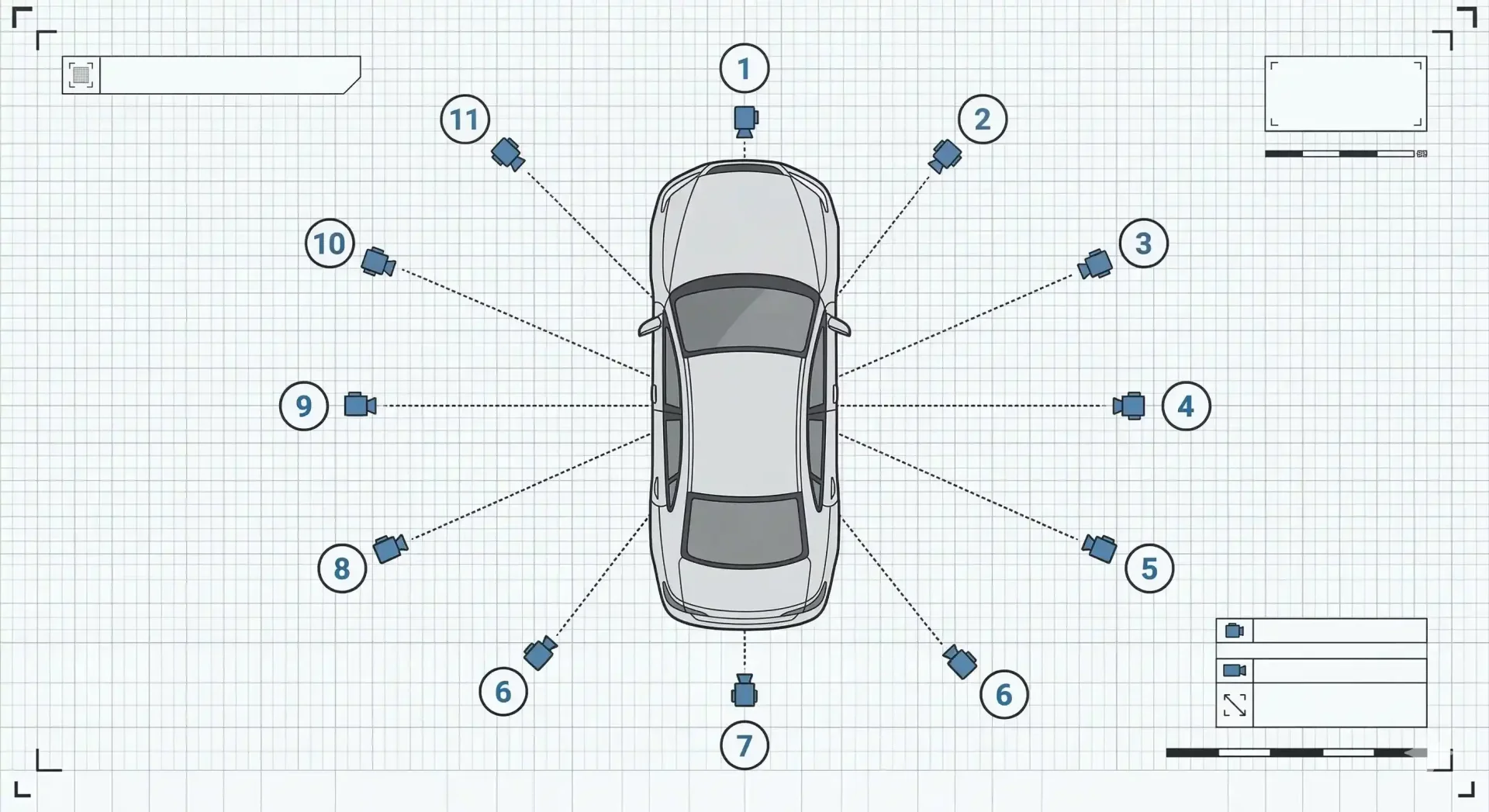
Car photography angles determine whether your listing photos look professional or amateur. Two dealers can shoot the same vehicle with the same phone in the same lighting, and the one who nails the angles will produce a listing that earns more clicks, more inquiries, and faster sales. The difference is not talent or equipment. It is knowing which positions around the vehicle consistently produce the most informative, trust-building images.
This guide covers the 11-shot standard sequence that covers every angle a buyer needs to see, the car photography techniques that make each shot work, and how to train any staff member to shoot dealer inventory consistently.
The 11-shot standard sequence for car photography angles
This is the baseline shooting sequence used by professional automotive photographers and high-performing dealerships. Each angle serves a specific purpose in the buyer decision process.
Shot # | Angle | What it shows the buyer | Camera height |
|---|---|---|---|
1 | Front three-quarter (driver side) | Primary listing image. Shows front face + body line + proportions. | Hip height |
2 | Rear three-quarter (passenger side) | Confirms body condition from the opposite angle. Shows tail design. | Hip height |
3 | Driver side profile | Full body line, wheel condition, paint condition along the longest view. | Hip height |
4 | Passenger side profile | Confirms no damage on the opposite side. | Hip height |
5 | Front straight-on | Grille, headlights, bumper condition, symmetry check. | Bumper height |
6 | Rear straight-on | Tail lights, bumper, exhaust, hitch (trucks), badge. | Bumper height |
7 | Dashboard and center console | Interior condition, screen, controls, mileage. | Headrest height from rear seat |
8 | Rear seats | Legroom, upholstery condition, amenities. | From front seat looking back |
9 | Trunk or cargo area | Cargo capacity, liner condition, spare tire. | Standing behind vehicle |
10 | Odometer close-up | Verified mileage for trust. | Close-up, steady hand |
11 | VIN plate | Verification for serious buyers running history reports. | Close-up |
This sequence takes 8-12 minutes per vehicle with a phone. The front three-quarter shot (position 1) is your hero image, the one buyers see first in marketplace grids. Get this one right and everything else is supporting evidence.
Best angles for car photography: why three-quarter wins
The front three-quarter angle is the default hero shot for a reason. It shows the vehicle face (grille, headlights, bumper), the body profile (doors, roofline, wheel design), and enough depth to convey the car's proportions, all in a single frame.
Shoot this angle from approximately 45 degrees off the front corner, at hip height, with the camera about 10-15 feet from the vehicle. Hip height is critical. Shooting from eye level or above makes the car look smaller and less substantial. Shooting from too low creates a dramatic look that can feel misleading on a listing.
The rear three-quarter from the opposite corner mirrors this logic. Together, these two shots give the buyer a nearly complete picture of the vehicle exterior before they even click through to the full gallery. Among all the best angles for car photography, these two produce the highest engagement on marketplace listings.
Car photography techniques that improve every angle
Beyond knowing where to stand, these car photography techniques improve image quality regardless of the specific shot.
Keep the horizon level. A tilted horizon makes the car look like it is parked on a hill, even when the lot is flat. Most phone cameras have a built-in grid overlay and level indicator. Turn them on and use them for every shot.
Leave breathing room around the vehicle. Do not crop the car tight to the frame edges. Leave 10-15% of the frame as empty space around the vehicle. This gives AI post-processing room to add backgrounds cleanly and prevents marketplace cropping from cutting off mirrors or antennas.
Turn the wheels slightly toward the camera. On exterior shots, turning the front wheels about 15-20 degrees toward the camera shows the wheel and tire design. Straight wheels look flat and lifeless. This subtle adjustment adds dimension to every side and three-quarter shot.
Avoid shooting into reflections. Glass and paint reflect everything. Position yourself so you are not shooting into a reflection of yourself, other cars, or bright objects. A slight side step is usually enough to clear the reflection zone.
Clean before you shoot. This is a technique, not just preparation. Water spots, fingerprints on glass, and dust on the hood all show up in photos and cannot be cleanly removed in post-processing without looking artificial.
Settings for car photography on phones and cameras
You do not need manual camera controls to shoot good inventory photos, but knowing a few settings for car photography makes a noticeable difference.
Setting | Phone recommendation | Camera recommendation | Why |
|---|---|---|---|
Mode | Auto or HDR | Aperture priority (f/5.6-f/8) | HDR balances bright sky and dark underbody in one exposure |
Flash | Off (always) | Off | Flash creates harsh reflections on paint and glass |
Zoom | No digital zoom (use feet) | 50-85mm equivalent | Digital zoom degrades quality. Walk closer instead. |
Orientation | Landscape | Landscape | Matches marketplace display and shows full vehicle profile |
Resolution | Maximum (12MP+) | Large JPEG or RAW | Preserves detail for cropping and post-processing |
Grid overlay | On | On | Helps keep the horizon level |
The single most impactful setting is HDR mode on phones. It captures multiple exposures and combines them, which solves the most common lot photography problem: a properly exposed car with a blown-out sky, or a nice sky with a dark underbody. HDR handles both in one shot.
How to take car photography consistently across staff
The biggest challenge in dealer photography is not the technique itself. It is getting consistent results when multiple staff members shoot vehicles across different days and conditions. Here is how to take car photography quality from variable to standardized.
Print the 11-shot sequence as a laminated card that fits in a pocket or clips to a lanyard. Every staff member follows the same sequence in the same order. This eliminates the "I forgot the trunk shot" and "I only shot 6 angles" problems that create rework.
Designate a single "photo spot" on your lot. This is the cleanest area with the least background clutter, ideally with a neutral backdrop (plain wall, open sky, clean pavement). Every car gets shot in the same spot. Consistency in location means consistency in lighting conditions and backgrounds.
Schedule shoots at the same time daily. A 9 AM shoot window means every vehicle is photographed in similar light. Mixing morning and afternoon shoots across vehicles creates the exact inconsistency that AI background replacement then has to correct.
Run a weekly 5-minute review. Pull up the last 10 vehicles listed and check: are all 11 angles present? Is the horizon level? Are the three-quarter shots at hip height? Quick calibration prevents quality drift over time.
Common car photography tips most dealers miss
These car photography tips address specific problems that surface repeatedly in dealer inventory photos.
Open the driver door slightly for the dashboard shot. A fully closed door creates a narrow, awkward angle through the window. Opening it 30-40 degrees gives the camera a clear, wide view of the full dashboard, center console, and steering wheel.
Shoot the trunk from slightly above. Standing directly behind the vehicle and shooting straight into the trunk produces a dark, flat image. Step back and angle the camera slightly downward to capture depth and show the full cargo space.
For the odometer shot, turn the vehicle to the ON position (not running) to illuminate the gauge cluster. A dark, unlit odometer is hard to read in photos and fails to build the transparency that serious buyers expect.
On trucks and SUVs, add a shot from a slightly elevated position (standing on a step stool or curb) to show the bed or roof. This bird's-eye-adjacent angle is one of the best angles for car photography on taller vehicles that buyers cannot easily see over.
Finally, do not skip the AI enhancement step. Even well-shot photos benefit from lighting normalization and background consistency. The angles get you good raw material. Post-processing turns it into professional listings.
Final thoughts
Mastering car photography angles is the single fastest way to improve your listing quality without spending money on equipment. The 11-shot standard sequence, shot at hip height with a level horizon and breathing room around the vehicle, gives buyers everything they need to move from browsing to inquiry. Print the sequence, train your team, and lock in a consistent daily workflow. Then try CarBG free on your next batch to see how consistent angles combined with AI post-processing produce a professional catalog from ordinary lot photos.
Frequently asked questions
What are the most important car photography angles for listings?
The front three-quarter and rear three-quarter angles are the two most important shots. Together, they give buyers a nearly complete picture of the vehicle exterior. The front three-quarter is your hero image, the first photo buyers see in marketplace grids. Shoot both at hip height from approximately 45 degrees off the front and rear corners.
How many angles should I shoot per vehicle?
The 11-shot standard sequence covers every angle a buyer needs: front and rear three-quarter, both side profiles, front and rear straight-on, dashboard, rear seats, trunk, odometer, and VIN plate. Some marketplaces accept up to 40 images, so you can add detail shots of wheels, headlights, or special features beyond the baseline 11.
What car photography techniques prevent amateur-looking photos?
Three techniques make the biggest difference. Keep the horizon level using your camera grid overlay. Shoot at hip height rather than eye level to give the car visual weight. Leave 10-15% breathing room around the vehicle in the frame so marketplace cropping does not cut off mirrors or antennas. These three adjustments alone transform most lot photos from casual to professional.
What settings for car photography work best on smartphones?
Use HDR mode to balance bright skies and dark underbodies in a single exposure. Keep flash off to avoid reflections on paint and glass. Shoot at maximum resolution (12MP+) in landscape orientation. Turn on the grid overlay to keep your horizon level. Avoid digital zoom entirely. Walk closer to the vehicle instead.
How do I train staff on how to take car photography consistently?
Print the 11-shot sequence as a laminated pocket card. Designate one "photo spot" on the lot with the cleanest background. Schedule a consistent daily shoot window for even lighting. Run a weekly 5-minute review of the last 10 vehicles listed to catch quality drift early. These four steps standardize output across any number of staff.
Do I need different angles for trucks vs sedans?
The 11-shot baseline works for all vehicle types. For trucks and SUVs, add one elevated shot from a step stool or curb to show the bed or roof, which buyers cannot see from ground level. For convertibles, add one shot with the top down. These extras take 60 seconds and address vehicle-specific buyer questions before they are asked.
75 E 3rd street, Sheridan, WY, 82801, USA
