
Car Backdrop Selection Guide for Dealer Listing Templates
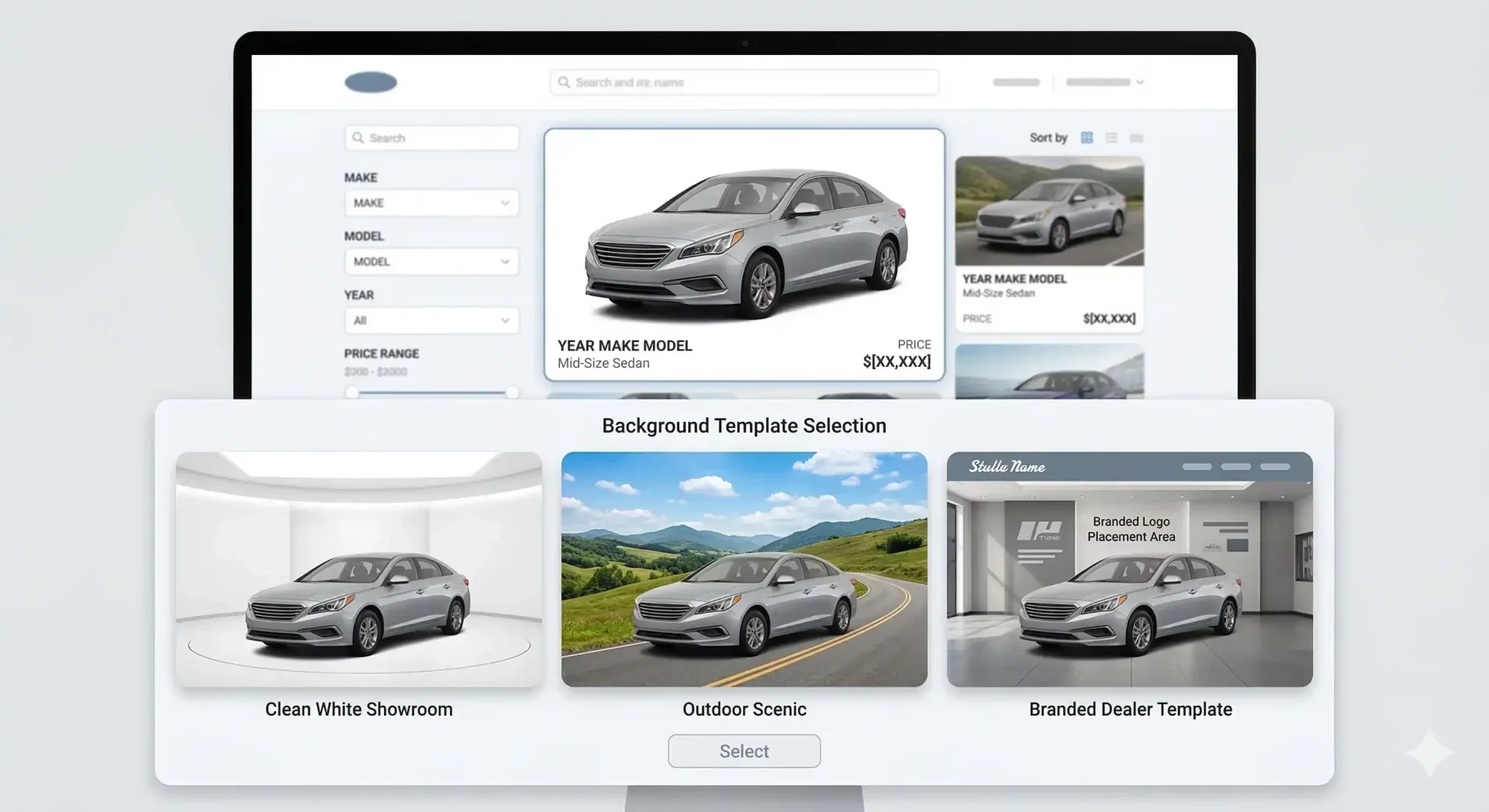
Choosing a car backdrop for dealer listings is a decision you make once and apply to hundreds of vehicles. Get it right, and every listing on your inventory page looks like it came from a professional catalog. Get it wrong – or keep switching between options – and the page looks disjointed regardless of how good the individual photos are. This guide narrows the decision to what actually matters for dealership-scale operations: which template types work, how to test them, and how to scale one backdrop across your entire inventory.
If you want to see the options in action, CarBG's template library lets you test showroom, outdoor, and neutral backdrops on your own vehicle photos in seconds.
Why a consistent car backdrop drives listing performance
The car backdrop is not about aesthetics for its own sake. It is about creating a pattern that buyers recognize and trust. When every vehicle in your inventory appears against the same backdrop, the inventory page communicates three things: this dealership has a standardized process, this dealership invests in presentation, and every vehicle receives the same level of care.
The opposite – a mix of lot photos, edited photos, studio shots, and phone snapshots – communicates that the operation is ad hoc. Buyers may not articulate this, but they feel it. The consistent-backdrop dealership gets more clicks per vehicle because the overall page signals professionalism before the buyer examines any individual listing.
Data from automotive marketplace platforms supports this. Dealers who standardize their car backdrop across inventory see measurable improvements in listing engagement compared to their pre-standardization performance. The effect is cumulative: the more vehicles that share the same visual standard, the stronger the catalog impression becomes.
Showroom car backdrops for professional dealer catalogs
Showroom backdrops simulate a dealership showroom environment: polished floor, soft ambient lighting, subtle architectural elements (columns, gradient walls), and neutral tones that complement any vehicle color. They are the most popular choice for dealers who want a professional look without the clinical starkness of pure white.
What makes a good showroom backdrop
The floor surface is the most important element. A polished, slightly reflective floor creates a premium impression and naturally anchors the vehicle to the scene. The reflection beneath the car serves the same visual function as a shadow – it proves the car is sitting on a real surface rather than floating in space. Soft gradient lighting on the back wall prevents the background from competing with the vehicle for attention.
Avoid showroom backdrops with too much detail: visible furniture, plants, other vehicles, or busy architectural features. These elements draw the eye away from the car and defeat the purpose of the background replacement. The best showroom backdrops are clean enough to feel like a premium environment but empty enough to keep the focus on the vehicle.
Which vehicles suit showroom backdrops
Showroom backdrops work particularly well for luxury, premium, and certified pre-owned inventory. The polished environment matches buyer expectations for vehicles in the $30,000+ range. For economy and budget inventory (see our broader automobile background ideas guide for the full range of options), a showroom backdrop can feel slightly incongruous – a 2015 Corolla on a glossy showroom floor might over-promise the buying experience. For budget stock, a clean white or light gray backdrop tends to feel more honest.
Outdoor car backdrops that work for specific vehicle types
Outdoor backdrops can enhance specific vehicle types when the environment matches the vehicle's natural use case. The key is intentional matching, not random scenic selection.
Vehicle type | Effective outdoor backdrop | Why it works |
|---|---|---|
Trucks and full-size SUVs | Open road, mountain vista, construction-adjacent | Capability context. The environment suggests what the vehicle can handle. |
Convertibles and sports cars | Coastal highway, winding mountain road | Lifestyle aspiration. The road suggests freedom and driving pleasure. |
Family SUVs and minivans | Suburban street, park entrance | Relatability. The setting mirrors the buyer's actual use environment. |
Electric vehicles | Modern urban architecture, clean cityscape | Progressive context. The environment reinforces the forward-thinking purchase. |
The critical constraint: if you use an outdoor car backdrop for one vehicle in your inventory, use the same outdoor backdrop for all vehicles of that type. A truck on a mountain road next to a truck on a white floor looks inconsistent. Commit to your choice per vehicle category and apply it uniformly.
Branded car backdrops with dealer logo and colors
Branded backdrops add dealership identity elements to the background: a logo in the corner, brand colors in the accent lighting, or a subtle watermark. This approach is most valuable for dealer groups operating multiple locations where brand consistency across the group is a strategic priority.
How to brand without cluttering
The most effective branded car backdrops are subtle. A small logo in the lower right corner at 15 to 20% opacity. Brand-colored accent lighting in the showroom gradient (a warm amber for a luxury brand, a cool blue for a modern brand). A thin colored stripe along the floor edge. These elements register subconsciously without competing with the vehicle.
Avoid large logos, centered text, watermarks across the vehicle body, or high-contrast brand elements that fight the car for attention. The backdrop's job is to present the vehicle professionally with a hint of brand identity, not to serve as advertising space. If the brand element is the first thing a viewer notices, it is too prominent.
CarBG's consistent dealer branding feature – which will automatically apply logo and color elements across all processed images – is in the making. In the meantime, branded templates with pre-placed logo zones are available in the template library for manual customization.
How to choose one car backdrop template and scale it across inventory
The selection process should be systematic, not based on gut feel. Here is the approach that works for dealerships of any size.
Step 1: gather a test batch
Select 5 to 8 vehicles from your current inventory that represent your typical mix: one light-colored, one dark-colored, one white, one silver or gray, one truck or SUV, and one sedan or compact. These cover the range of situations your template must handle. The template vs custom background comparison explains why template consistency beats custom selection per vehicle.
Step 2: process against two to three candidates
Run the test batch through your top two or three backdrop candidates. If using CarBG or a similar tool, this takes minutes. If evaluating manually, mock up the composites for at least the hero shot of each test vehicle.
Step 3: evaluate at thumbnail size
Shrink each result to marketplace thumbnail dimensions (roughly 300 by 225 pixels). This is the size buyers actually see in search results. A backdrop that looks stunning at full resolution may be invisible or overly busy at thumbnail scale. Check that: the vehicle silhouette reads clearly against the backdrop, dark cars do not disappear into dark backgrounds, light cars do not wash out against white backgrounds, and the shadow or reflection is visible enough to anchor the vehicle.
Step 4: commit and deploy
Select the backdrop that performs best across your test batch. Apply it to your next full inventory cycle (30 to 60 days of new listings). Resist the urge to switch mid-cycle. The power of a car backdrop is in its consistency over time, not in finding the single perfect option. A good template applied to 100 vehicles builds a stronger brand impression than a perfect template applied to 20 before switching to something else.
Testing and iterating on your car backdrop selection
After your initial 30 to 60 day commitment, review the results before renewing or changing.
Check engagement data. Compare listing views, click-through rates, and inquiry volume for the period with the new backdrop versus the previous period. If engagement improved, keep the template. If it stayed flat or declined, the backdrop may need adjustment – but verify that other variables (pricing, inventory mix, seasonal trends) did not confound the comparison.
Review edge cases. Scroll through your processed inventory and identify any vehicles where the backdrop produced a suboptimal result. Extremely dark or extremely bright vehicles may need a backdrop adjustment, but this should affect fewer than 10% of your inventory. If more than 10% of vehicles look problematic, the template choice needs revisiting.
Gather team feedback. Ask your sales team whether buyers have commented on photo quality – positively or negatively. Dealers running bulk processing pipelines often find that the sales team notices the change before the engagement data catches up, because buyers arriving at the lot mention that the online photos looked professional.
Final thoughts
The right car backdrop is the one you commit to and apply consistently. Showroom templates suit most dealer inventories. Outdoor scenes serve specific vehicle types for marketing. Branded backdrops reinforce dealer group identity. Test with a representative batch, evaluate at thumbnail size, and deploy for a full inventory cycle before reconsidering. CarBG's template library makes testing and deploying backdrops a same-day exercise, which means the distance between considering a change and seeing it on your live listings is measured in minutes, not weeks.
Frequently asked questions about car backdrops for dealers
What is the best car backdrop for a used car dealership?
A light gray studio or neutral showroom backdrop works best for the majority of used car dealerships. It is professional without being aspirational, complements all paint colors, and scales consistently across mixed inventory. Dealers who carry a range of vehicles from budget to premium can use one neutral backdrop for standard inventory and one showroom backdrop for premium units, keeping the total template count to two for the entire operation.
How many car backdrop options do I need?
One to two templates cover virtually all dealership needs. A primary template (white, light gray, or showroom) handles standard inventory. An optional secondary template adds distinction for premium or certified vehicles. More than two templates introduces the visual inconsistency that backdrop standardization is designed to eliminate. The value of a car backdrop comes from repetition, not variety.
Should I add my dealer logo to my car backdrop?
Subtle logo placement can reinforce brand identity, especially for dealer groups with multiple locations. The key is subtlety: a small logo at 15 to 20% opacity in a corner, not a large watermark across the vehicle or background. If the brand element distracts from the car, it is too prominent. Some marketplace platforms also have rules against logos or text in listing photos, so verify platform guidelines before adding branding elements.
How do I test which car backdrop works best for my inventory?
Process a representative batch of 5 to 8 vehicles (varied colors and body types) against two or three candidate backdrops. Review the results at marketplace thumbnail size, not full resolution. Check that every vehicle reads clearly against the background regardless of paint color and that the shadow anchoring looks natural. Select the backdrop that works best across the full range of your test vehicles, then commit to it for at least one full inventory cycle of 30 to 60 days.
Can I use different car backdrops for different vehicle categories?
You can, but limit it to two categories maximum (for example, standard inventory on white and premium inventory on a showroom backdrop). More than two creates the patchwork effect on your inventory page that undermines the professional impression. If you differentiate by category, apply the category rule consistently: every truck gets backdrop A, every sedan gets backdrop B. Random per-vehicle selection defeats the purpose.
Do car backdrops need to change with seasons or trends?
No. Backdrop consistency over time is more valuable than following visual trends. A dealership that uses the same professional backdrop for 12 months builds a stronger brand impression than one that changes quarterly. The only reason to change a backdrop is if engagement data clearly shows it underperforming, or if your brand identity evolves significantly. Seasonal photo themes work for social media marketing content but should not affect inventory listing backdrops.
75 E 3rd street, Sheridan, WY, 82801, USA
