Car Photo Studio: Physical vs Virtual AI Compared
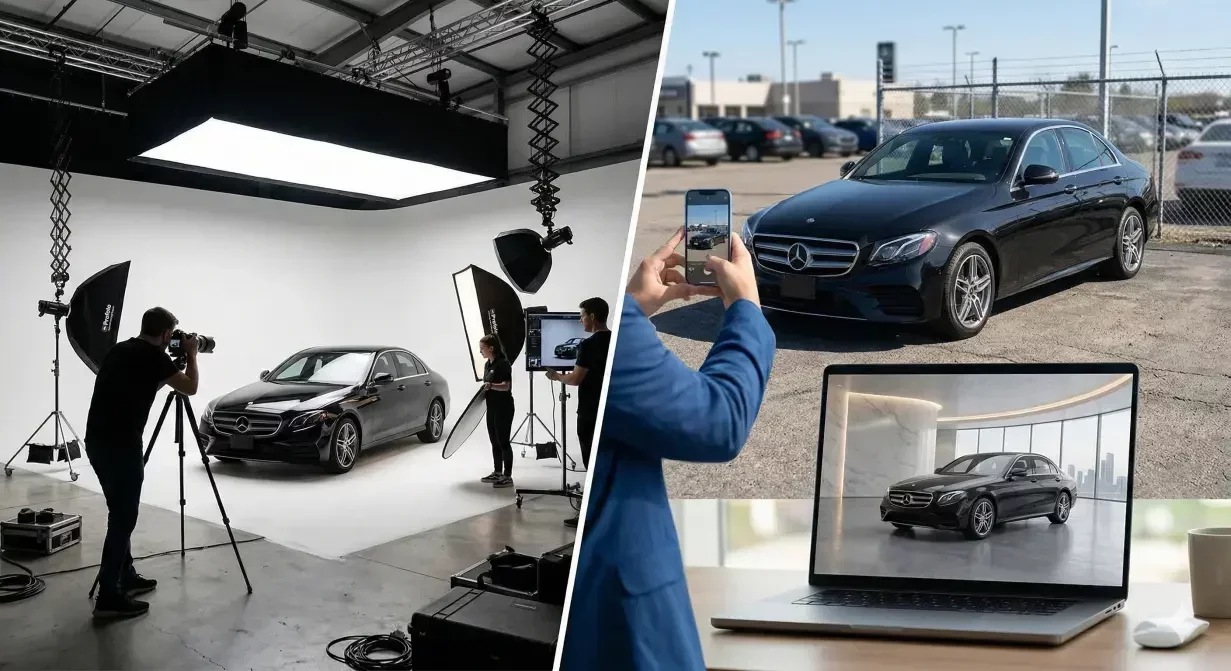
A car photo studio – whether physical or virtual – is the infrastructure that turns raw inventory captures into consistent, branded listing images. For decades, the only option was a dedicated space with professional lighting, backdrops, and the labor of driving each vehicle in and out. Today, AI-powered virtual studios produce comparable results from a phone photo taken anywhere on the lot.
This comparison breaks down both approaches across cost, throughput, quality, and practicality for different dealership sizes. If you want to test the virtual approach immediately, Car Background AI's AI car photo editor processes lot photos into studio-quality results in seconds.
What a car photo studio does for dealer listings
The purpose of any car photography studio setup is consistency. When a buyer scrolls your inventory page, every vehicle should look like it belongs to the same professional catalog. Same background, similar lighting, consistent color rendering. This visual uniformity signals organization, credibility, and care – three qualities that directly influence buyer trust and click-through rates.
Without a studio process (physical or virtual), the inventory grid becomes a patchwork of different lot locations, weather conditions, and photographer skill levels. Studies from marketplace platforms indicate that listings with consistent, professional imagery receive significantly more engagement than those with unprocessed lot photos.
Physical car photo studio setups
A traditional car photo studio requires dedicated indoor space, typically a minimum of 30 feet by 40 feet for standard sedans and SUVs. Larger vehicles (trucks, full-size vans) need 40 by 60 feet or more. The space must accommodate the vehicle plus camera distance, lighting stands, and crew movement.
Equipment and costs
The core investment includes several components:
- Cyclorama wall or seamless paper system: $3,000 to $15,000.
- Studio strobes or continuous LED panels (four to eight): $4,000 to $20,000.
- Turntable for 360-degree capture: $10,000 to $30,000, optional.
- Camera equipment: $2,000 to $5,000.
Total initial investment typically ranges from $15,000 to $50,000 or more, depending on quality level and whether 360 capability is included.
Ongoing costs are significant. Backdrop replacement (seamless paper gets tire marks), lighting maintenance, space rental or dedicated allocation within the dealership, and dedicated staffing. Most physical studios require at least one full-time operator.
Throughput and scheduling
A well-run physical car photo studio processes 8 to 15 vehicles per day. Each vehicle requires driving into the studio, positioning, photographing a full set of angles, and driving out. The process takes 20 to 40 minutes per vehicle including vehicle movement. For a dealership turning over 50 to 100 vehicles monthly, this means dedicating 4 to 12 full days per month exclusively to photography.
Virtual car photo studio with AI
A virtual car photo studio uses AI to achieve the same visual result without physical infrastructure. The photographer captures images wherever the vehicle sits – the lot, the service bay, the delivery area – and AI processes the photos into studio-quality output.
How it works
The AI detects the vehicle silhouette, removes the existing background, replaces it with a selected studio backdrop (showroom floor, neutral gray, branded background), normalizes lighting to match the backdrop, enhances color for consistency, and adds realistic shadow grounding. The entire process takes 2 to 5 seconds per image.
Car Background AI is built specifically for this automotive use case. Unlike generic background removal tools that struggle with vehicle-specific challenges – wheel spokes, mirror edges, antenna details, window transparency – Car Background AI's AI is trained on car silhouettes and handles these edge cases reliably at scale.
Throughput and flexibility
The throughput difference is the core advantage. A single person with a phone can capture 50 vehicles on the lot in a morning, then batch-process all images through the virtual studio in minutes. No vehicle movement. No scheduling around studio availability. No weather dependency. Photos can be captured and processed the same day a vehicle arrives, which directly reduces time-to-listing. Our guide on building a bulk car background processing pipeline covers the full workflow for high-volume operations.
Cost comparison for car photo studios
Cost factor | Physical studio | Virtual AI studio (Car Background AI) |
|---|---|---|
Initial investment | $15,000 – $50,000+ | Free trial, then per-image pricing |
Monthly operating cost | $2,000 – $5,000 (space, staff, maintenance) | $60 – $300 (based on volume tier) |
Cost per vehicle (20-image set) | $15 – $40 (amortized) | $4 – $8 |
Space required | 1,200 – 2,400 sq ft minimum | None |
Dedicated staff | 1 full-time operator minimum | Existing staff (no dedicated role) |
Equipment maintenance | Ongoing (backdrops, bulbs, turntable) | None |
Breakeven (50 vehicles/month) | 12 – 24 months | Immediate |
For dealerships processing fewer than 200 vehicles monthly, the virtual studio is more cost-effective by a wide margin. For a full breakdown of the quality and speed tradeoffs, see our AI photo enhancer vs manual editing comparison. The initial investment difference alone – $0 versus $15,000+ – makes the virtual approach accessible to independent dealers and small groups that could never justify a physical studio.
When a physical studio still makes sense
Physical studios retain advantages in specific scenarios. OEM-certified dealerships with manufacturer photography standards may require physical studio setups to maintain compliance. Dealerships specializing in exotic or collectible vehicles where buyers expect editorial-quality imagery benefit from the creative control a physical studio provides. High-volume franchise groups processing 500+ vehicles monthly may find the per-unit economics of a physical studio competitive, especially if the studio doubles as a customer delivery experience space.
For marketing content – hero shots for website banners, social media campaigns, and advertising – a physical studio still delivers a level of creative control that virtual studios cannot fully replicate. The ideal approach for larger operations is a combination: virtual AI processing for inventory listings and physical studio time reserved for marketing content.
How to set up a virtual car photography studio
Transitioning from lot-only photography to a virtual studio workflow requires minimal setup. Here is the process from start to finish.
Step 1: standardize your capture process
Define a shot list (10 to 20 angles per vehicle), assign a shooting time window (overcast mornings are ideal), and distribute the quick-reference settings to your team. The capture does not need to be perfect – it needs to be consistent and complete.
Step 2: select your studio templates
Choose 2 to 3 background templates that match your brand. Most dealers use a clean white or light gray for the primary background, with a showroom or outdoor scene as a secondary option. Consistency matters more than variety. Pick your templates once and apply them across the entire inventory. Our comparison of car background templates vs custom backgrounds breaks down which approach scales better for different operation sizes.
Step 3: batch-process through Car Background AI
Upload your vehicle photo sets to Car Background AI's bulk processing tool. Select your template, apply it across the batch, and let AI handle background removal, lighting correction, and color enhancement. Review the output for any edge cases that need manual attention (rare, but worth checking on the first few batches).
Step 4: export and publish
Download the processed images in marketplace-ready formats. Upload to your website, Cars.com, CarGurus, AutoTrader, and any other listing platforms. The entire process – capture to published listing – can happen within the same day a vehicle arrives on the lot.
Final thoughts
The car photo studio has evolved from a physical space to a digital service. For the majority of dealerships, a virtual AI studio delivers equal listing quality at a fraction of the cost, with dramatically higher throughput. The vehicles that used to wait days for studio time can now be listed the same afternoon they arrive. Try Car Background AI on your next batch of lot photos and compare the results against your current process – most dealers see the difference on the first set.
Frequently asked questions
How much does it cost to set up a car photo studio at a dealership?
A physical car photography studio typically costs $15,000 to $50,000 for initial setup including backdrop systems, professional lighting, and optionally a vehicle turntable. Ongoing monthly costs add $2,000 to $5,000 for space, staffing, and maintenance. A virtual AI studio through Car Background AI starts with a free trial and scales based on volume, with per-image costs under $1 for high-volume plans. Most dealerships under 200 vehicles per month find the virtual approach significantly more economical.
Can a virtual car photo studio match the quality of a physical one?
For marketplace listing photos, yes. AI-processed images from a virtual car photo studio produce backgrounds, lighting, and color consistency that are visually comparable to physical studio output on Cars.com, CarGurus, and AutoTrader listings. The difference becomes noticeable in high-end marketing applications where creative lighting direction and custom compositions are needed. For the 95% of dealership photography that goes into listings, virtual studios match or exceed physical studio quality at scale.
How many vehicles can a virtual car photography studio process per day?
A single person can capture 30 to 50 vehicles on the lot and process the full image sets through an AI virtual studio in a single workday. This compares to 8 to 15 vehicles per day with a physical studio. The speed advantage comes from eliminating vehicle movement – cars stay where they are on the lot, and all studio processing happens digitally after capture.
Do I need special equipment for a virtual car photo studio?
No. A modern smartphone is sufficient for capture. The AI processing handles lighting normalization, background replacement, and color correction regardless of the capture device. A basic tripod or stabilizer can improve consistency, but most dealership teams shoot handheld successfully. The entire "studio" is the AI software.
What is the best auto photo studio option for a small dealer?
A virtual AI studio is the clear choice for small dealers. The zero upfront investment, no space requirements, and per-image pricing model eliminate the financial risk that makes physical studios impractical for operations under 100 vehicles monthly. Small dealers can achieve the same visual consistency as franchise dealerships with physical studios, leveling the competitive playing field on marketplace listings.
Can a car photo studio handle 360-degree vehicle photography?
Physical studios with turntables are designed for 360-degree capture, producing interactive spins for listings. Virtual AI studios currently focus on static image enhancement rather than 360-degree composites. If interactive 360 spins are a requirement, a physical turntable setup or a dedicated 360 photography service is still the best option. For standard listing photos (the vast majority of dealership photography needs), virtual studios are more practical.
How does a virtual car photo studio maintain brand consistency?
Template-based processing ensures every image uses the same background, lighting profile, and color settings. Once you select your templates in the AI studio, every vehicle is processed identically regardless of the original shooting conditions. This eliminates the inconsistency that occurs when different staff members shoot at different times and locations. The result is a uniform inventory grid that reinforces your dealership brand across every listing platform.