Types of Car Photoshoot Every Dealer Should Know
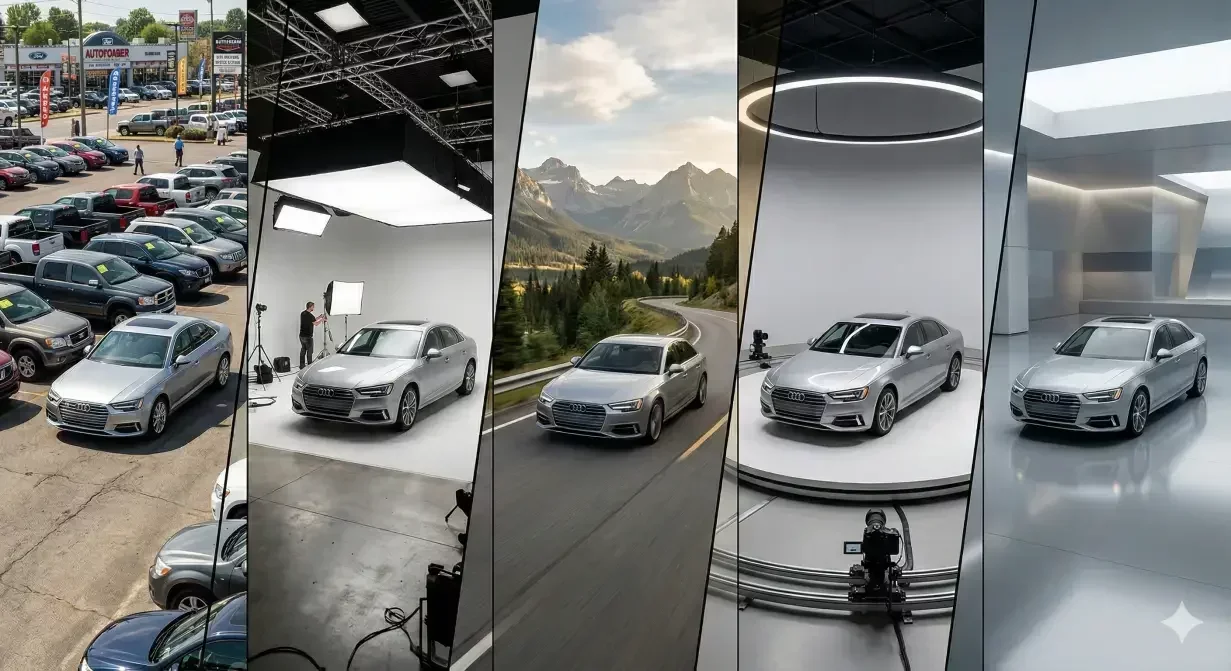
A car photoshoot is the single most controllable factor in how fast your inventory sells online. Buyers scroll past listings with messy, inconsistent photos. They slow down for vehicles that look clean, well-lit, and intentional. Yet most dealerships default to one method – quick phone shots on the lot – without realizing there are five distinct approaches, each suited to different goals, budgets, and listing types.
This guide breaks down every type of automotive photoshoot used by dealers today, from the daily lot walkthrough to AI-processed virtual studios. By the end, you will know which method fits your operation, where each one falls short, and how to combine approaches for a consistent, scalable listing workflow. If you want to skip the studio rental entirely, tools like Car Background AI's AI car photo editor can bridge the gap between a phone-shot lot photo and a studio-quality result.
At a glance
- Lot photography
- Studio car photography
- Lifestyle and location shoots
- 360-degree spins
- AI-processed car photography
Lot photography: the daily driver for dealerships
Lot photography is the workhorse of dealership inventory imaging. Staff walk the lot, shoot each vehicle where it sits, and upload the photos for listing. It is fast, free beyond labor cost, and requires no special equipment beyond a phone or basic camera.
The advantages are obvious: every vehicle gets photographed the same day it arrives. There is no scheduling, no moving cars to a separate space, and no waiting for a photographer. For high-turnover dealerships processing dozens of vehicles weekly, lot photography is the only method that scales without additional headcount.
The disadvantages are equally clear. Backgrounds are cluttered with other vehicles, signage, fencing, and pavement. Lighting depends entirely on weather and time of day. One salesperson shooting at noon produces completely different results than another shooting at 4 PM. The result is an inventory grid that looks inconsistent, which signals disorganization to buyers.
Lot photography works best when paired with a post-processing pipeline. Capture on the lot, then run photos through a car image enhancer to standardize backgrounds and lighting. This keeps the speed of lot shooting while eliminating its visual inconsistency.
Making lot photography work: a quick SOP
Standardize the process with these steps.
- Shoot during the same two-hour window each day – overcast mornings are ideal.
- Use a consistent sequence: front three-quarter, rear three-quarter, driver side, passenger side, front direct, rear direct, interior dash, interior rear, engine bay, odometer. For a full breakdown of angles and framing, see our 12-shot car photography angle template.
- Avoid shooting toward the sun.
- Keep the vehicle centered in frame with roughly 10% padding on each side.
- Upload the full set to your editing pipeline the same day.
Studio car photography for premium listings
Studio photography places the vehicle in a controlled environment with professional lighting, a clean backdrop, and no visual distractions. The results are striking: perfect reflections, even exposure, and a look that signals premium quality.
The cost is the problem. A basic in-house car photography studio requires a dedicated space large enough to fit a vehicle plus lighting rigs – typically 30 by 40 feet minimum. Add seamless backdrop paper or a cyclorama wall, four to six studio strobes, and you are looking at $15,000 to $50,000 in setup costs before the first photo is taken. Ongoing costs include backdrop replacement, bulb replacements, and the labor of physically moving each vehicle in and out of the space.
Studio photography makes sense for flagship vehicles, certified pre-owned showcases, and marketing hero shots. It does not make sense for every vehicle in a 200-unit lot. The throughput bottleneck – moving cars in, shooting, moving cars out – limits studio work to roughly 8 to 12 vehicles per day even with a dedicated team.
Lifestyle and location shoots for marketing
Lifestyle shoots place the car in a context that tells a story: a convertible on a coastal road, an SUV at a trailhead, a luxury sedan in front of a high-rise. These images are not for inventory listings. They are for social media, website hero banners, advertising campaigns, and brand-level marketing.
The production effort is significant. Location scouting, permits, talent (if human models are involved), and a professional automotive photographer mean a single lifestyle shoot can cost $2,000 to $10,000 per vehicle. Scheduling depends on weather, golden-hour timing, and location availability.
For dealers, lifestyle photography is best reserved for a handful of marquee vehicles each quarter. The content feeds social media and paid ads, driving brand awareness rather than individual unit sales. Trying to apply this method across your entire inventory is neither practical nor cost-effective.
360-degree spins for interactive listings
360-degree photography captures a vehicle from every angle in a continuous rotation, allowing buyers to interactively spin the car on the listing page. Platforms like Cars.com and AutoTrader increasingly support this format, and buyer engagement data shows that 360 spins increase time-on-listing and reduce bounce rates.
The equipment ranges from dedicated car turntables ($10,000 to $30,000) to software-based solutions that stitch images from a fixed shooting path. Physical turntables require a flat, level surface and a space large enough for the turntable plus camera clearance. Software stitching requires shooting 24 to 72 evenly spaced photos around the vehicle, which demands either a marked floor or a track system.
Throughput is limited. Even with a turntable, capturing a full 360 spin takes 10 to 20 minutes per vehicle. For dealers with tight listing deadlines, this method supplements standard photography rather than replacing it.
AI-processed car photography: the hybrid approach
AI-processed photography is the newest category, and it changes the economics of every method listed above. The concept is simple: shoot with whatever method is fastest (usually lot photography), then use an AI car photo editor to transform the output into something that looks studio-grade.
Background removal and replacement is the core capability. An AI tool detects the vehicle silhouette, strips the cluttered lot background, and replaces it with a clean showroom or outdoor backdrop. Advanced tools also correct lighting, enhance color, and add realistic shadow grounding so the car does not appear to float. For a deeper look at how AI handles exposure problems, see our guide on AI lighting optimization for car photos.
The speed difference is dramatic. A car photoshoot on the lot takes 5 to 10 minutes per vehicle for capture. AI processing takes 2 to 5 seconds per image. A team of two can photograph and fully process 50 vehicles in a single afternoon, something that would take a week with traditional studio methods.
This is where Car Background AI fits the dealership workflow. It is built specifically for automotive imagery – trained on vehicle silhouettes, handling mirrors, wheels, and reflections that trip up generic background removal tools. The output is a consistent, branded set of listing images that work across Cars.com, CarGurus, AutoTrader, and Facebook Marketplace.
What AI processing handles well
Background replacement, lighting normalization, color enhancement, and consistent export formatting. These are the four operations that consume the most manual editing time, and AI handles all of them in seconds.
What AI processing does not replace
AI cannot fix a fundamentally bad photo. If the vehicle is poorly framed, out of focus, or shot from the wrong angle, no amount of post-processing will save it. Good capture technique remains essential – AI just removes the tedious post-production work.
Choosing the right car photoshoot type for your operation
Method | Cost per vehicle | Time per vehicle | Best for | Limitation |
|---|---|---|---|---|
Lot photography | $0 (labor only) | 5 – 10 min | Daily inventory | Inconsistent backgrounds |
Studio photography | $15 – $50+ (amortized) | 15 – 30 min | Flagship vehicles | Low throughput, high setup cost |
Lifestyle shoots | $2,000 – $10,000 | 1 – 4 hours | Marketing campaigns | Not scalable for inventory |
360-degree spins | $10 – $30 (amortized) | 10 – 20 min | Interactive listings | Equipment cost, space needed |
AI-processed (lot + AI) | Under $1 per image | 5 min capture + seconds processing | Full inventory at scale | Cannot fix bad source photos |
Most high-volume dealerships benefit from a combination: lot photography for daily inventory processed through AI, with studio or lifestyle shoots reserved for marketing content. This approach maximizes throughput while maintaining a professional, consistent look across all listings. Choosing the right backdrop matters too – our comparison of car background templates vs custom backgrounds covers which option scales better for different dealer sizes.
Final thoughts
Every car photoshoot method has a place in the dealership toolkit, but none works in isolation for high-volume operations. Lot photography gives you speed. Studio gives you polish. AI processing bridges the gap, turning fast lot captures into consistent, marketplace-ready sets. The dealers gaining an edge right now are the ones combining fast capture with AI standardization – photographing on the lot and processing through tools like Car Background AI to deliver a full listing pack the same day a vehicle hits the lot.
Frequently asked questions
What is the fastest type of car photoshoot for dealerships?
Lot photography combined with AI post-processing is the fastest method available. A team can capture 50 vehicles in a single afternoon using phones or basic cameras, then process the entire batch through an AI tool in minutes. This eliminates the scheduling delays and throughput limits of studio setups while still delivering clean, consistent listing images.
How many photos should a dealership take per vehicle during an automotive photoshoot?
Most marketplaces display 15 to 30 images per listing, but the ideal capture set is 20 to 25 images per vehicle. This includes standard exterior angles (front three-quarter, rear three-quarter, both sides, front direct, rear direct), interior shots (dashboard, rear seats, trunk), and detail shots (wheels, badges, odometer). Having a few extra shots gives your editing team options without slowing down the capture process.
Can AI replace a professional car photography studio?
For inventory listing photos, yes. AI background replacement tools produce results that are visually comparable to studio output for the purpose of online marketplace listings. For high-end marketing campaigns, editorial features, or print advertising, a physical studio with professional lighting still delivers a level of control that AI cannot fully replicate. The practical answer for most dealers is to use AI for inventory and reserve studio time for marketing content.
What equipment do I need for a basic car photoshoot on a dealership lot?
A modern smartphone with a quality camera is sufficient for lot photography. iPhones from the 12 series onward and flagship Android devices produce images that are sharp enough for marketplace listings, especially when paired with AI enhancement. A basic tripod or stabilizer helps with consistency but is not strictly necessary. The more important investment is in a standardized shooting process and post-processing pipeline.
How much does a professional automotive photoshoot cost?
Costs vary dramatically by method. Lot photography costs nothing beyond staff time. An in-house studio setup runs $15,000 to $50,000 for equipment and space, with ongoing maintenance. Hiring a professional automotive photographer for a lifestyle shoot ranges from $2,000 to $10,000 per session. AI-processed photography through tools like Car Background AI costs under $1 per image, making it the most economical option for high-volume operations.
What car photoshoot mistakes reduce listing performance?
The three most common mistakes are inconsistent backgrounds (different locations, lighting, and angles across the inventory grid), poor framing that cuts off bumpers or mirrors, and shooting in harsh midday light that creates deep shadows. All three make the inventory page look unprofessional and reduce buyer trust. Standardizing the capture process and running photos through a consistent editing pipeline eliminates most of these issues.
Is a car photoshoot studio worth the investment for a small dealer?
For most small dealers, no. The space requirements, equipment costs, and throughput limitations of a physical studio do not justify the investment when you can achieve similar listing-quality results by shooting on the lot and processing through an AI tool. The breakeven point where a physical studio starts making financial sense is typically above 200 vehicles per month, and even then, only if the studio is also used for marketing content.

Tamas Magda
Co-founder, Growth and Partnerships at Car Background AI
Tamas Magda is co-founder of Car Background AI (carbackground.ai, CarBG), an AI car photo editor that replaces backgrounds on dealership inventory photos. He leads partnerships, growth, and business architecture, working with the development team on the product roadmap and with dealers on what their online listings actually need. He brings a background in venture building across APAC and MENA, and writes about vehicle merchandising, dealer photo workflows, and using AI on listing images without altering the car itself.
Tamas is a co-founder of Car Background AI and has a financial interest in the company. Articles that mention Car Background AI reflect that relationship.