Løsning af brandafvigelser: Når forhandlersteder ikke længere følger fotostandarder
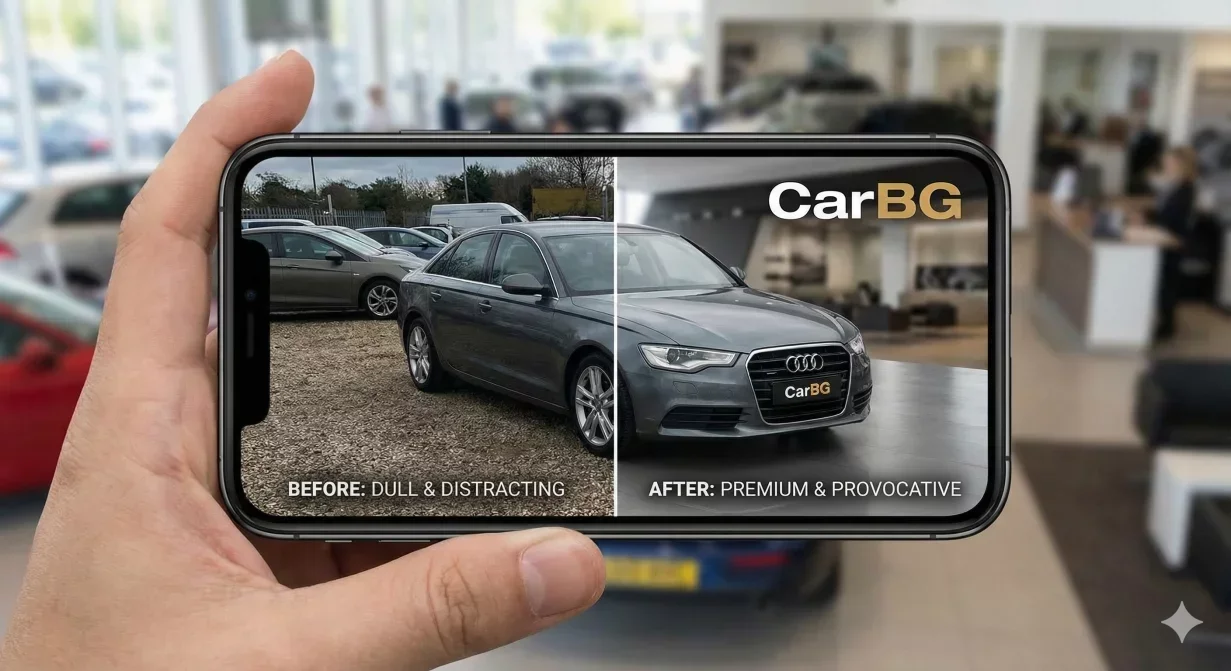
Brand drift happens when dealer locations gradually deviate from established photo standards. Car background quality plays a critical role in this process. It rarely happens suddenly; instead, small variations accumulate until visual consistency has eroded significantly. This guide helps dealer group managers identify brand drift, diagnose its causes, and implement corrections.
Recognizing brand drift
Brand drift often goes unnoticed because it happens incrementally. Warning signs include:
- Visual inconsistency across locations
- Standards document disconnection
- New employee confusion
- Quality audit score divergence
Browse your group's inventory on a marketplace that shows all locations together. Can you easily tell which location produced which photos based on visual style? If so, drift has occurred.
Diagnosing drift causes
Effective correction requires understanding why drift occurred. Different causes require different solutions.
- Unclear or outdated standards: Standards that were never clear enough, or have not been updated, invite interpretation. Solution: Revise documentation with greater specificity and visual examples.
- Template proliferation: What started as few approved templates expanded to many options. Solution: Audit all templates, consolidate to minimal approved set, establish change control.
- Training decay: Initial training established common understanding, but that has decayed through turnover and memory fade. Solution: Refresh training for all staff using updated materials.
- Tool changes without process updates: Tools were updated but procedures were not. Solution: Update procedures to match current tools, standardize configurations.
- Local management override: Location managers made local decisions without group approval. Solution: Clarify authority boundaries, review local changes for potential adoption or require compliance.
- Lack of accountability: No one monitors or addresses non-compliance. Solution: Implement regular auditing, make metrics visible, enforce consequences.
Correction process
Work through the correction in sequence:
- Establish baseline by documenting current state across all locations.
- Define target state with clear, unambiguous compliance criteria.
- Communicate expectations directly to all locations.
- Provide resources needed to comply.
- Monitor progress with interim audits.
- Address persistent issues through escalation.
- Prevent recurrence through ongoing governance.
Handling resistance
Location managers sometimes resist returning to standards. Acknowledge local concerns and listen to why deviation occurred. Explain brand value and how individual optimization hurts collective brand. Offer change request path for genuinely better approaches. Enforce when necessary after good-faith efforts.
How Car Background AI prevents and corrects drift
Car Background AI supports drift prevention through centralized template management. Approved templates are available to all locations; unauthorized templates are not.
The platform's consistent processing ensures locations using approved templates produce identical outputs.
Final thoughts
Brand drift undermines visual consistency that builds buyer trust. Recognize drift early, diagnose causes before jumping to solutions, correct systematically, and prevent recurrence through ongoing governance. Implement Car Background AI for architectural controls that prevent drift before it starts.
Frequently asked questions
How quickly should I expect brand drift correction?
Allow two to four weeks for locations to achieve compliance once expectations and resources are clear.
Should I correct all locations simultaneously or one at a time?
Simultaneous correction creates peer accountability and prevents some locations from feeling singled out.
What if our standards are the problem, not location compliance?
Common drift in similar directions may indicate original standards were unrealistic. Revise standards based on learnings.
How do I prevent drift after correction?
Ongoing auditing, regular training refreshes, template controls, and management accountability for quality metrics.
What consequences should non-compliance have?
Progressive consequences: coaching, formal feedback, performance documentation, and ultimately personnel action if necessary.

Tamas Magda
Medstifter, vækst og partnerskaber hos Car Background AI
Tamas Magda er medstifter af Car Background AI (carbackground.ai, CarBG), en AI-billededitor til biler, der udskifter baggrunde på forhandleres lagerfotos. Han står i spidsen for partnerskaber, vækst og forretningsarkitektur og arbejder med udviklingsteamet på produktkøreplanen og med forhandlere om, hvad deres onlineannoncer faktisk har brug for. Han har en baggrund inden for venture building i APAC og MENA og skriver om præsentation af køretøjer, forhandleres fotoarbejdsgange og brugen af AI på annoncebilleder uden at ændre selve bilen.
Tamas er medstifter af Car Background AI og har en økonomisk interesse i virksomheden. Artikler, der nævner Car Background AI, afspejler denne relation.