
Night Car Photography and Best Lighting by Time of Day
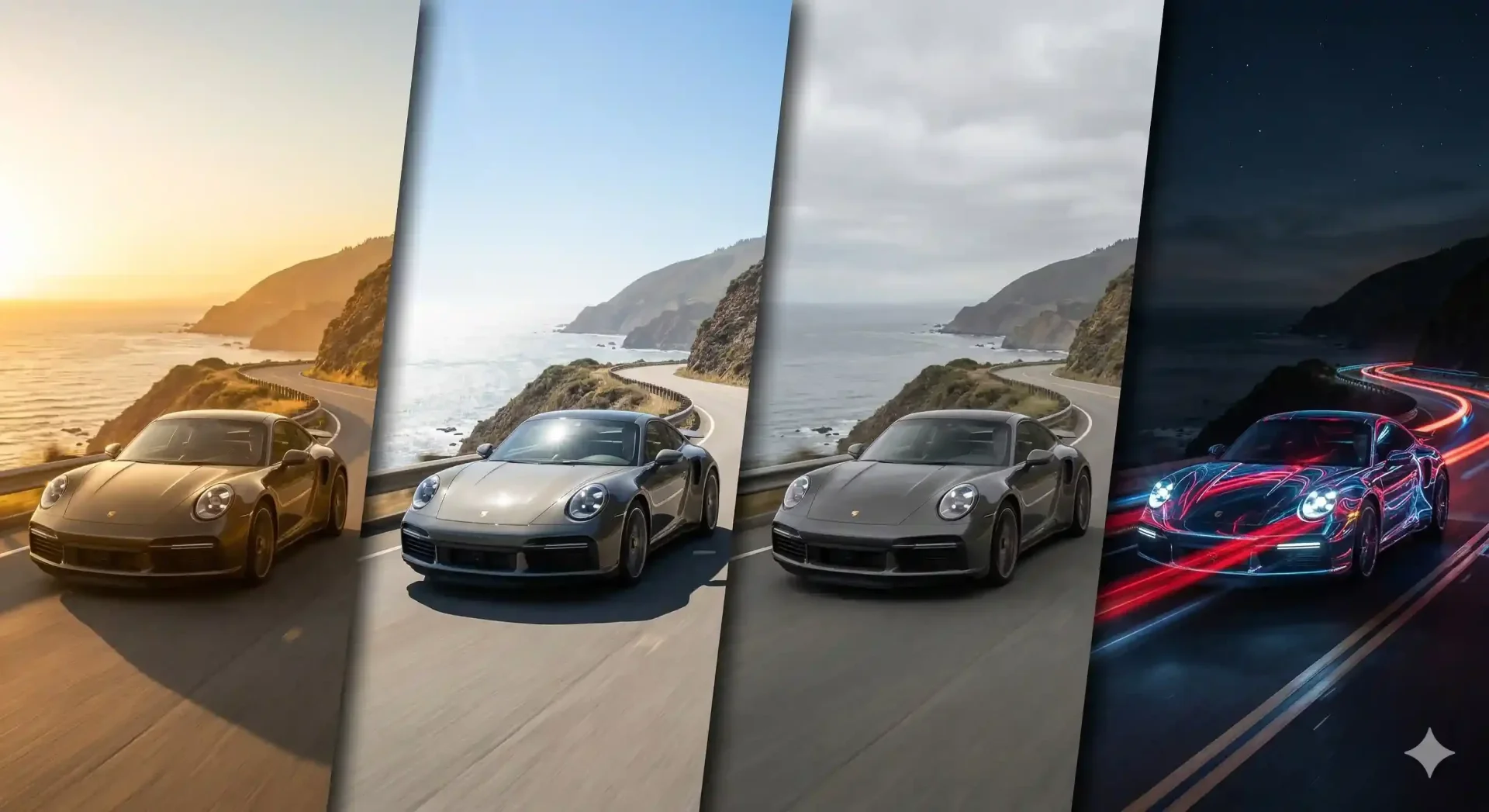
Night car photography is the most visually dramatic form of automotive imaging, but it is also the hardest to execute consistently. Long exposures, artificial light sources, and deep shadows create opportunities for stunning marketing content – and equally create opportunities for unusable, noisy, badly exposed images that waste everyone's time.
This guide covers car photography lighting across every condition your dealership will encounter, from golden hour to midnight. Each section includes specific settings and positioning advice so your team can capture usable photos regardless of the clock. For the shots where conditions are less than ideal, CarBG's AI lighting optimization can correct exposure problems that would otherwise require a reshoot.
Golden hour car photography for dealership listings
Golden hour – the 60 to 90 minutes after sunrise and before sunset – produces the most naturally flattering light for car photography. The sun sits low on the horizon, casting warm, directional light that adds depth to paint surfaces and creates gentle shadows that define the vehicle's body lines without harsh contrast.
For dealership use, golden hour has one significant limitation: the window is narrow. If your lot team needs to photograph 15 vehicles, golden hour only accommodates 4 to 6 before the light shifts too much for visual consistency across the set. The warm color temperature also shifts rapidly during this window, meaning the first and last vehicle photographed may look noticeably different in white balance.
Making golden hour work for dealer volume
Pre-stage all vehicles before the light arrives. Have them washed, prepped, and positioned in the photo area so the team can move straight into shooting when conditions are right. Assign the most important or highest-value vehicles to the golden hour slot and shoot the remainder during the overcast morning or in shade. Lock white balance to "Cloudy" (6000K) rather than Auto to prevent the camera from compensating for the warm tones you actually want.
Midday sun: challenges and workarounds
Midday (roughly 10 AM to 2 PM in most locations) is the most common shooting window for dealerships because it fits between morning meetings and afternoon customer traffic. It is also the worst light for car photography. The overhead sun creates deep shadows under bumpers, in wheel wells, and along lower door panels. Chrome and glass produce harsh specular highlights that blow out in the image. The overall look is flat and unflattering.
If midday is your only option, position the vehicle so the sun is behind and slightly to one side of the photographer – never directly overhead from the camera's perspective. This moves the deepest shadows to the side and underside of the vehicle rather than the front face. Use a reflective windshield shade (most dealerships have these) laid flat on the ground in front of the car to bounce fill light into the shadow under the front bumper.
Expose for the shadow areas and accept that highlights may clip slightly. AI post-processing recovers blown highlights more easily than it lifts crushed shadows. If your team uses phones, lock exposure on the darkest panel and resist the urge to pull exposure down – the shadows are more important to preserve than the sky.
Overcast days: the hidden advantage for car photography at night and day
Overcast skies are the single best natural light source for high-volume dealership car photography. The cloud layer acts as a massive diffuser, scattering sunlight evenly across the entire scene. Shadows are soft, highlights are controlled, and the color temperature stays consistent throughout the day. There is no rush to catch a fleeting window.
The practical advantage for dealerships is throughput. On an overcast day, every hour between 8 AM and 4 PM produces usable, consistent light. Your team can photograph 30 to 50 vehicles without worrying about shifting shadows or color drift. The resulting photo sets look uniform, which matters when they appear together on your inventory page.
The only adjustment needed is a slight exposure increase (+0.3 to +0.7 EV or one tap up on a phone). The gray sky fools camera meters into underexposing the vehicle because the meter averages the bright sky with the darker car. Compensating for this produces a correctly exposed vehicle against a slightly bright but even background – ideal for AI background replacement later.
Night car photography techniques for marketing content
Night car photography serves a different purpose than inventory listing photos. Listings need clean, well-lit images where every detail is visible. Night photography creates mood, drama, and visual interest for social media, website hero banners, advertising campaigns, and brand-level marketing content. The techniques are fundamentally different.
Equipment for night time car photography
A tripod is non-negotiable for night car photography. Shutter speeds will range from 1 to 30 seconds depending on ambient light, and no one hand-holds steadily at those durations. A remote shutter release (or the phone's timer function) eliminates camera shake from pressing the button. A portable LED panel ($50 to $200) gives you a controllable fill light to paint specific areas of the vehicle during long exposure car photography.
Settings for night car photography
On a DSLR or mirrorless camera, start with aperture at f/5.6 to f/8, ISO at 100 to 400, and shutter speed at 5 to 15 seconds. The long exposure captures ambient light from streetlamps, building lights, and the sky. On a phone, enable Night Mode and stabilize against a surface or tripod. Phone Night Mode typically captures a 3 to 5 second exposure and computationally stacks the frames, producing surprisingly usable results for social media.
Light painting for dramatic results
Light painting is the signature technique of night car photography. During a long exposure (10 to 30 seconds), walk around the vehicle with an LED panel, flashlight, or even a phone screen, directing light across the body panels. The camera records the accumulated light as a smooth, even wash. The result looks like studio lighting but with the drama of a nighttime environment.
Start with one pass along each side of the vehicle, holding the light at a 45-degree angle downward. Keep the light source moving – pausing in one spot creates hot spots. Two to three passes per side at different heights fills in shadows and creates dimensional depth. Bracket by shooting 5 to 8 exposures with slightly different light painting paths, then pick the best.
Positioning the vehicle relative to the light source
Regardless of time of day, the relationship between the vehicle, the light source, and the camera determines the quality of the photo. This is the single most overlooked car photography technique on dealer lots.
Light position | Result | Best for |
|---|---|---|
Sun/light behind photographer | Even, front-lit exposure. Minimal shadows on the visible side. | Inventory listing hero shots |
Sun/light at 45 degrees to the side | Directional light creates body line definition and depth. | Marketing photos, feature highlights |
Sun/light behind the vehicle (backlit) | Dramatic rim light on edges, dark front. High contrast. | Night photography, lifestyle content |
Overhead (midday) | Flat, shadowless top. Deep shadows underneath. | Avoid for car photography when possible |
For inventory listings, front-lit or slightly side-lit positions produce the most consistently usable photos. For marketing and social media, side-lit and backlit positions create visual interest. For night car photography, backlighting with streetlamps or building lights creates the rim-light effect that defines the technique. The key for any car photoshoot is making the positioning decision before pressing the shutter, not trying to fix it afterward.
When AI lighting correction saves the shot
Even with proper timing and positioning, real-world lot conditions produce imperfect light. A passing cloud shifts exposure mid-set. A building casts a shadow across half the vehicle. The team shoots at noon because the car needs to be listed today. These situations happen daily, and they do not require a reshoot when AI tools are part of the pipeline.
AI lighting optimization normalizes exposure across the entire image, lifting shadows and taming highlights to produce an evenly lit result. It corrects the green color cast from covered-lot fluorescents, the warm shift from late-afternoon sun, and the blue cast from deep shade. For dealership car photography workflows, this means the team can shoot in any condition and still deliver a consistent-looking set.
What AI cannot fix: fundamental exposure failures where the image is nearly black or completely white with zero recoverable detail. It also cannot create three-dimensional lighting from a flat, shadowless source – the light painting and positioning covered earlier still matter for creating depth. The practical approach is to capture the best light available, accept that conditions will not always be perfect, and let AI handle the normalization so every vehicle in the inventory looks like it was photographed under the same conditions.
Final thoughts
Night car photography and every other time-of-day approach each serve a specific purpose in your dealership's visual strategy. Golden hour and overcast mornings deliver the most efficient inventory captures. Midday works with repositioning and exposure compensation. Night photography creates marketing content that stops social media scrollers. The connecting thread is intentional lighting – understanding what each condition gives you and adjusting your approach accordingly. For everything the light does not deliver, CarBG's AI processing bridges the gap between what the camera captured and what the listing needs.
Frequently asked questions about car photography lighting
What equipment do I need for night car photography?
At minimum, you need a tripod and a camera or phone capable of long exposures. A remote shutter release prevents camera shake. For light painting, a portable LED panel or bright flashlight works well – dedicated photography lights are better but not required for social media content. Phone Night Mode on modern flagships (iPhone 13+, Samsung Galaxy S22+, Pixel 7+) produces usable night car photography results without any additional equipment.
What is the best time of day for dealership car photography?
Overcast mornings between 8 AM and 10 AM offer the most forgiving light for high-volume inventory photography. The diffused light eliminates harsh shadows and allows consistent shooting throughout the window. If overcast conditions are not available, the hour after sunrise or before sunset (golden hour) provides warm, directional light. Midday shooting is workable with proper positioning but produces the most post-processing work.
Can I use night car photography for inventory listings?
Night photography is generally not suitable for standard inventory listings because marketplace platforms require well-lit, detail-visible images where buyers can clearly see the vehicle's condition. Night car photography excels as marketing content – social media posts, website banners, and advertising campaigns where mood and visual impact matter more than inspectable detail. Use daytime captures for listings and reserve night shoots for your marketing calendar.
How does long exposure car photography work?
Long exposure car photography uses slow shutter speeds (typically 5 to 30 seconds) to accumulate light over time. The camera sensor stays open, recording ambient light from streetlamps, buildings, and the sky, while light painting adds controlled illumination to the vehicle. The result is a bright, dramatically lit vehicle against an ambient-lit background. A tripod is essential because any camera movement during the exposure creates blur across the entire image.
How do I fix inconsistent lighting across a set of car photos?
Inconsistent lighting within a photo set typically happens when shooting conditions change between vehicles – a cloud passes, the sun moves, or different staff shoot at different times. The most effective fix is AI batch processing, which normalizes exposure, white balance, and color rendering across all images in the set simultaneously. This produces a uniform look regardless of the original shooting conditions, which is critical for inventory pages where all vehicles appear side by side.
What car photography lighting mistakes reduce listing performance?
Three lighting mistakes consistently hurt listing clicks. First, shooting directly into the sun, which silhouettes the vehicle and hides all front-facing detail. Second, photographing in mixed light (partial sun, partial shade), which creates uneven exposure across the vehicle body. Third, using flash in an outdoor setting, which produces an unnatural, flat look with harsh shadows behind the car. All three are avoidable with proper positioning and timing, and all three are difficult to fully correct in post-processing.
75 E 3rd street, Sheridan, WY, 82801, USA
